Introduction
Taiwan has spent the last four decades building a reputation as one of the most important electronics manufacturing hubs on the planet. From semiconductors to printed circuit boards to finished consumer devices, the island’s supply chain touches nearly every piece of modern technology in some way. Within that ecosystem sits a company that, while less flashy than the giant foundries that dominate headlines, plays a quietly essential role: Artron Tech Inc Taiwan.
Artron Tech Inc is an Electronics Manufacturing Services (EMS) provider based in Taipei, offering everything from surface mount technology (SMT) assembly to full turnkey contract manufacturing. It operates as part of a much larger multinational network built around its Japanese parent company, and its story reflects broader trends in how Asian manufacturing has evolved — from simple contract assembly work in the early 1990s to sophisticated, highly automated production lines capable of serving demanding global clients today.
The Origins of Artron Tech Inc
Artron Tech Inc traces its roots back to January 1993, when it was established in Taiwan as a wholly owned subsidiary of TOA Electric Industrial Co., Ltd., a Japanese company. At the time, the company was known by a different name — TOATECH INC — reflecting its close ties to its Japanese parent. It would later be renamed ARTRON TECH INC as part of a broader corporate rebranding effort across the parent group’s global subsidiaries.
In its early years, the company set up a factory in the Xizhi District of New Taipei City, where it focused primarily on printed circuit board (PCB) contract manufacturing. The early business was narrowly focused: providing flexible printed circuit (FPC) assembly services for Japanese customers in the film camera industry. This was a strategically smart niche. In the early-to-mid 1990s, Japan’s camera and consumer-electronics manufacturers were looking for cost-effective, high-quality contract manufacturing partners in Asia, and Taiwan — with its growing base of skilled electronics technicians and proximity to Japan — was a natural fit.
That early bet paid off. According to the company’s own account of its history, strong product quality and efficient service delivery allowed the business to grow quickly within just a few years of opening its doors. As demand increased, the company needed more space and better infrastructure, which led to a significant relocation.
Growth and Relocation to Neihu
In 2005, the company expanded and relocated to the Neihu District of Taipei City, an area that has since become one of Taipei’s key technology and innovation districts, home to numerous electronics, software, and hardware companies. The move to Neihu wasn’t just about square footage — it coincided with a substantial technological upgrade. The company invested in Surface Mount Technology (SMT) production lines, which significantly boosted its manufacturing capacity and allowed it to handle far more complex and higher-volume orders than the FPC assembly work that had defined its first decade.
This shift from a narrow PCB assembly shop to a broader EMS operation mirrors a pattern seen across much of Taiwan’s electronics sector during the 2000s. As global electronics brands increasingly outsourced manufacturing to Asia, companies that could offer more comprehensive services — not just board assembly, but design support, testing, and full production runs — were better positioned to win and retain business. Artron Tech Inc’s investment in SMT capability was a direct response to that industry-wide shift.
What Artron Tech Inc Does Today
Today, Artron Tech Inc positions itself as a comprehensive EMS manufacturer. Its services span the entire OEM (Original Equipment Manufacturer) process, from design and assembly through to testing, in order to meet diverse customer requirements. In practical terms, this means the company can take a client from early-stage product design guidance all the way through to a finished, tested product ready for shipment.
The core service categories the company offers include:
Surface Mount Technology (SMT): This is the modern standard for placing electronic components directly onto the surface of printed circuit boards, replacing older through-hole methods for most applications. SMT allows for smaller, denser, and more efficient board designs — critical for the miniaturized electronics that dominate today’s market.
DIP (Dual In-line Package) Assembly: While SMT dominates modern board assembly, some components — particularly those requiring higher mechanical strength or heat tolerance — still use through-hole DIP packaging. Offering both SMT and DIP gives Artron Tech Inc flexibility to handle a wider variety of component types and legacy designs.
OEM and ODM Manufacturing: As an Original Equipment Manufacturer, Artron Tech Inc builds products according to a client’s specifications and branding. As an Original Design Manufacturer (ODM), it can also contribute to product design itself, offering clients a more collaborative, engineering-driven relationship rather than pure contract assembly.
Full-Process Contract Manufacturing: The company markets itself as delivering a full spectrum of electronics manufacturing services, which suggests it aims to be a one-stop partner rather than a narrow subcontractor limited to a single stage of production.
Inside the Factory: Equipment and Capabilities
One of the more revealing details about Artron Tech Inc’s positioning in the market comes from its description of factory equipment. Rather than trying to compete purely on scale with the massive contract manufacturers that dominate high-volume consumer electronics, the company appears to have carved out a niche around flexibility and precision manufacturing.
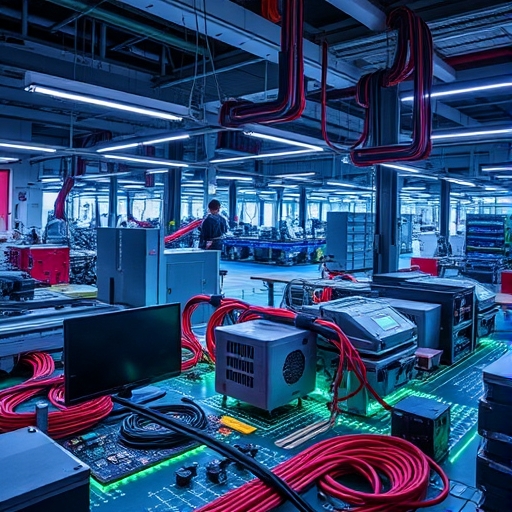
In terms of the physical equipment on the factory floor, the company’s disclosed capabilities include several categories of modern manufacturing technology:
- Solder printing machines, used to apply solder paste precisely onto PCB pads before component placement — the company specifically references SMT 3S solder printing machines as part of its line.
- High-speed mounters, the pick-and-place machines responsible for positioning components onto boards at speed and with tight tolerances. The factory is described as being equipped with state-of-the-art high-speed mounters.
- Automated Optical Inspection (AOI) systems, used to visually verify solder joints and component placement without manual inspection. The company notes it uses 2.5D high-speed AOI equipment as part of its quality process.
- Solder Paste Inspection (SPI) equipment, which checks solder paste deposits before components are even placed, catching defects earlier in the process rather than after assembly.
- Automated DIP flow soldering, supporting the through-hole components mentioned earlier.
- Automatic hand soldering machines, used for components or joints that require more delicate or specialized soldering than standard automated processes allow.
- 3D CT X-ray inspection, a more advanced quality-control technology capable of seeing inside solder joints and components — useful for catching hidden defects, such as voids in ball grid array (BGA) solder joints, that standard visual inspection cannot detect.
- AI camera control systems, suggesting the company has integrated machine-learning-assisted vision systems into parts of its quality control or production monitoring processes.
Artron Tech Inc’s Place Within a Larger Global Group
To understand Artron Tech Inc Taiwan fully, it helps to zoom out and look at the broader corporate structure it belongs to. The company is not a standalone entity; it is one node within an international network of subsidiaries connected to its Japanese parent, TOA Electric Industrial Co., Ltd.
This parent company, sometimes referred to as TOA Electric & Industrial Co., Ltd., has reportedly been in operation for more than 70 years, and the broader ARTRON group of companies has grown to include more than 35 offices and manufacturing plants across the globe. These locations span Japan, China, Hong Kong, Taiwan, Singapore, Malaysia, Thailand, Vietnam, India, Indonesia, the Philippines, Germany, and the United States.
This global footprint is significant. It means Artron Tech Inc Taiwan isn’t operating in isolation — it can potentially draw on group-wide resources, shared supplier relationships, and coordinated logistics across multiple manufacturing sites in different countries. For multinational clients looking for manufacturing partners with a presence in multiple regions (useful for diversifying supply chain risk, managing tariffs, or serving regional markets more efficiently), being part of a larger group like this can be a meaningful advantage over a purely local, single-site manufacturer.
Why Taiwan Remains a Strategic Manufacturing Base
Artron Tech Inc’s decision to root its manufacturing operations in Taiwan — and to keep investing in that base over three decades — reflects broader reasons why Taiwan has remained such an attractive location for electronics manufacturing, even as costs have risen and much of the region’s lower-value assembly work has shifted to places like Vietnam or mainland China.
- Deep technical talent pool: Taiwan’s education system and decades-long focus on electronics and semiconductor industries have produced a large base of engineers, technicians, and skilled factory workers who understand PCB assembly, quality control, and precision manufacturing at a level that’s difficult to replicate quickly elsewhere.
- Proximity to component suppliers: Taiwan is home to a dense ecosystem of component manufacturers, distributors, and semiconductor foundries. This proximity reduces lead times and logistics costs for manufacturers like Artron Tech Inc that need reliable, fast access to electronic components — something directly reflected in the company’s emphasis on component sourcing and VA/VE services.
- Strong ties with Japanese industry: Given Artron Tech Inc’s origins as a subsidiary of a Japanese parent company, its Taiwan operations benefit from decades of established relationships with Japanese customers, suppliers, and quality standards. Japanese manufacturers have long used Taiwan as a nearby, cost-effective manufacturing base while maintaining close oversight — a dynamic that has shaped much of Taiwan’s electronics industry since the 1980s and 1990s.
- Infrastructure and logistics: Taipei and the surrounding New Taipei City region, where Artron Tech Inc has operated throughout its history, offer strong transportation infrastructure, well-developed industrial zoning, and easy access to shipping and air freight — all important for a manufacturer serving international clients.
The Broader EMS Industry Context
To appreciate what a company like Artron Tech Inc contributes to the technology supply chain, it’s worth understanding the EMS industry more broadly. Electronics Manufacturing Services providers occupy a critical but often invisible position in the production of nearly every electronic device sold today. Rather than designing and selling their own branded products, EMS companies manufacture products on behalf of other companies — sometimes handling the entire production process, sometimes just specific stages like board assembly or final testing.
The global EMS industry includes massive players capable of producing millions of units of a single product, as well as smaller, more specialized manufacturers that focus on flexibility, precision, and rapid turnaround for lower-volume or highly customized products. Companies operating in this second category — which Artron Tech Inc appears to fit, given its emphasis on “compact factory” and high-mix, low-volume production — tend to serve a different kind of client than the giant contract manufacturers most people have heard of.
Typical clients for a mid-sized, flexible EMS provider include:
- Companies developing new hardware products who need a manufacturing partner capable of handling smaller initial production runs before scaling up.
- Established brands with diverse product lines that don’t justify dedicated, single-product production lines.
- Companies requiring specialized assembly work, such as legacy through-hole components alongside modern SMT components.
- Businesses that value close, hands-on collaboration with their manufacturer, including design input and component substitution recommendations, rather than a purely transactional, high-volume relationship.
This kind of positioning tends to reward manufacturers who can demonstrate strong quality control, engineering support, and flexibility — all traits that align with what Artron Tech Inc emphasizes in its own service descriptions.
Quality Control as a Competitive Differentiator
It’s worth spending a bit more time on quality control, since it’s one of the clearest ways a mid-sized EMS provider can differentiate itself from competitors, particularly when competing against lower-cost manufacturers elsewhere in Asia.
The equipment described in Artron Tech Inc’s factory — AOI systems, SPI equipment, and 3D CT X-ray inspection in particular — represents a layered approach to catching defects at multiple stages of production rather than relying on a single inspection point. This kind of multi-stage inspection strategy is generally associated with manufacturers serving customers in demanding industries, where a defective solder joint or misplaced component could lead to costly product failures, recalls, or safety issues.
The reference to AI-assisted camera control also suggests the company has been incorporating newer inspection technologies as they’ve become commercially available, rather than relying solely on older-generation optical inspection systems. As machine learning-based visual inspection has matured over the past several years, many manufacturers have adopted it to catch subtler defects — such as slight component misalignment or solder anomalies — that traditional rule-based AOI systems sometimes miss.
Challenges Facing Taiwanese EMS Manufacturers
No overview of a company like Artron Tech Inc would be complete without acknowledging the broader challenges facing Taiwan’s electronics manufacturing sector. These challenges shape the strategic choices companies like Artron Tech Inc have to make.
- Rising labor and operating costs: As Taiwan’s economy has developed, wages and operating costs have risen substantially compared to earlier decades, pushing many purely cost-driven manufacturing operations to relocate to lower-cost countries in Southeast Asia. This is part of why companies like Artron Tech Inc have leaned into higher-value, higher-mix manufacturing rather than competing purely on price for high-volume, low-complexity work.
- Global supply chain volatility: Component shortages, shipping disruptions, and geopolitical tensions have made supply chain management increasingly complex for manufacturers everywhere, including in Taiwan. A company’s ability to source components efficiently — an area Artron Tech Inc specifically highlights through its VA/VE and component substitution services — has become an increasingly important competitive factor.
- Geopolitical considerations: Taiwan’s unique geopolitical position adds a layer of complexity that manufacturers based there must navigate, particularly for companies serving international clients who may be evaluating supply chain risk and diversification strategies. Being part of a larger multinational group with manufacturing sites across multiple countries — as Artron Tech Inc is, through its parent group’s global network — can help mitigate some of this risk for customers by offering alternative production locations if needed.
- Talent competition: Taiwan’s technology sector, dominated by globally recognized names in semiconductors and electronics, creates strong competition for skilled engineering and manufacturing talent. Mid-sized EMS providers must compete for the same talent pool as much larger, better-known companies, making employee development and workplace culture an important strategic focus — something reflected in the company’s own stated emphasis on staff training programs and career development opportunities for its workforce.
What This Means for Potential Clients and Partners
For businesses considering Artron Tech Inc Taiwan, or similar mid-sized Taiwanese EMS providers, as a manufacturing partner, a few practical takeaways emerge from this overview:
- Flexibility over pure scale: If your product requires smaller batch sizes, frequent design iterations, or a mix of legacy and modern component types, a manufacturer built around high-mix, low-volume production may be a better fit than a massive contract manufacturer optimized purely for scale.
- Established track record matters: A company with three decades of continuous operation in the same general region, including successfully navigating a major facility relocation and technology upgrade, suggests organizational stability — a meaningful factor for companies making long-term manufacturing commitments.
- Group affiliation can offer risk mitigation: Being part of a larger, multinational manufacturing group can provide backup capacity, shared resources, and geographic diversification that a standalone factory cannot offer on its own.
- Investment in quality infrastructure signals seriousness: The range of inspection technology described — spanning optical, X-ray, and AI-assisted systems — suggests an ongoing commitment to catching defects early rather than relying on downstream testing alone.
- Component sourcing expertise adds value beyond assembly: For clients navigating a volatile global component market, a manufacturing partner with deep, long-standing sourcing relationships in Taiwan can meaningfully reduce both cost and lead-time risk.
Conclusion
Artron Tech Inc Taiwan may not carry the household-name recognition of Taiwan’s largest semiconductor foundries or electronics giants, but its history reflects many of the same forces that have shaped Taiwan’s broader rise as a global manufacturing hub. Starting from a modest PCB assembly operation serving Japanese camera manufacturers in the early 1990s, the company grew through strategic relocation, sustained investment in SMT and inspection technology, and integration into a much larger multinational manufacturing group with roots stretching back more than 70 years.
Today, the company positions itself as a flexible, quality-focused EMS partner capable of supporting everything from component sourcing and design collaboration to full-scale contract manufacturing, backed by a “compact factory” model built for high-mix, low-volume production. For businesses evaluating electronics manufacturing partners in Taiwan — particularly those with ties to Japanese supply chains or those needing flexible, precision-focused production rather than pure high-volume assembly — Artron Tech Inc represents a case study in how mid-sized Taiwanese manufacturers have adapted and endured across three decades of rapid technological and economic change.