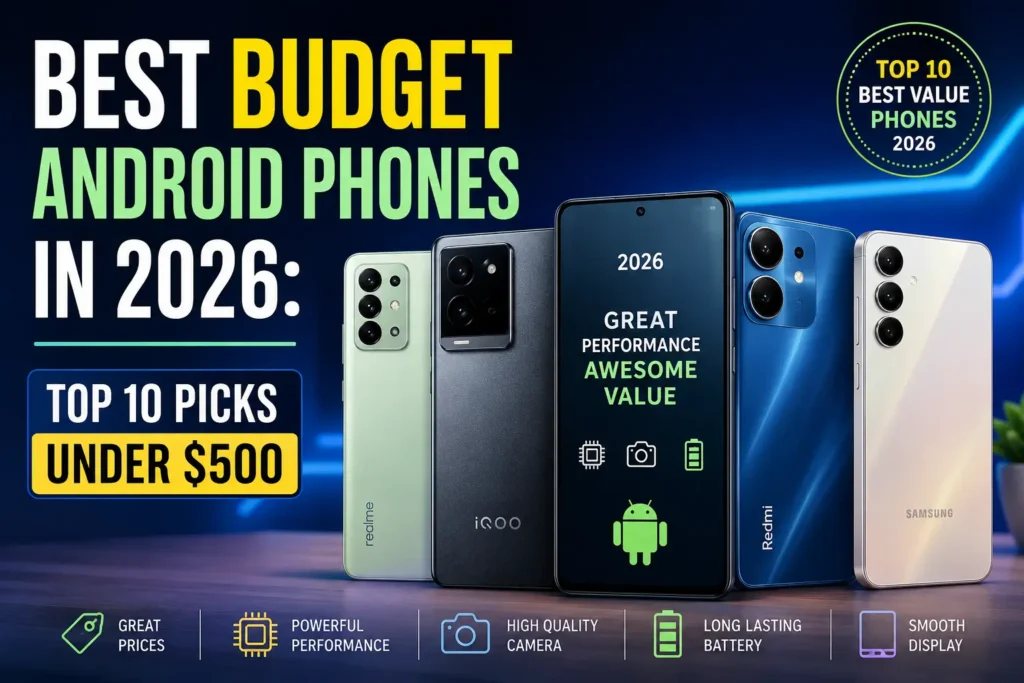
The days of “budget phone” meaning laggy performance, dim screens, and blurry cameras are over. In 2026, the best budget Android phones deliver 120Hz AMOLED displays, all-day batteries, capable AI cameras, and multiple years of software updates — all for a fraction of flagship prices. Whether you’re upgrading from an aging device, buying a phone for a family member, or simply refuse to spend four figures on a smartphone, this guide breaks down the best budget Android phones in 2026, what makes them worth buying, and how to pick the right one for your needs.
We’ve combed through the latest releases from Google, Samsung, Motorola, and Nothing to bring you a list of cheap Android phones that don’t feel cheap. Let’s dive in.
Why Budget Android Phones Are Better Than Ever in 2026
A few years ago, saving money on a phone meant sacrificing almost everything that made a smartphone enjoyable to use. That’s no longer the case. Three trends have converged to make 2026’s crop of affordable Android phones genuinely excellent:
- Chipset trickle-down: Processors that powered flagships just two or three years ago are now standard in mid-range and budget devices, meaning everyday tasks like browsing, streaming, and even light gaming feel smooth rather than sluggish.
- Longer software support: Samsung now promises six to seven years of OS updates on some budget models, and Google matches that with seven years of support for its Pixel A-series — numbers that were once reserved for premium phones only.
- AI features for everyone: On-device AI tools like Circle to Search, Call Screening, and AI photo editing have moved from flagship exclusives to standard features across nearly every price tier.
The result is a market where a $300–$500 phone can realistically serve as your daily driver for three-plus years without feeling outdated.
What to Look for in a Budget Android Phone
Before jumping into our picks, it helps to understand which specs actually matter when shopping for the best budget smartphones under $500.
- Software update policy — More years of OS and security updates means a longer usable lifespan and better resale value.
- Display quality — Look for AMOLED over LCD panels, and a 90Hz or 120Hz refresh rate for smoother scrolling.
- Battery life and charging speed — A 5,000mAh (or larger) battery paired with 25W+ charging is the sweet spot for all-day use.
- RAM — For most users, 8GB RAM is the sweet spot, offering smooth multitasking and better long-term performance without inflating the price too much.
- Camera consistency — Megapixel count matters less than sensor quality and software processing; a phone with a 48–50MP main sensor and solid image processing will usually beat one with more megapixels but weaker software.
- 5G connectivity — Even budget phones increasingly ship with 5G as standard, but it’s still worth double-checking on the cheapest models.
- Build quality and water resistance — An IP67 or IP68 rating adds real peace of mind and can extend the phone’s lifespan.
With that framework in mind, here are the best budget Android phones you can buy in 2026.
1. Google Pixel 10a — Best Overall Budget Android Phone
Price: Starting at $499 (128GB) / $599 (256GB)
The Google Pixel 10a is the clearest example of what makes a budget phone great in 2026. It carries over the Tensor G4 chip, 8GB of RAM, and a 5,100mAh battery from its predecessor, but Google has polished the experience with a brighter, more efficient 6.3-inch P-OLED display running at 120Hz, a flatter camera bump, and faster 30W wired and 10W wireless charging.
What really sets the Pixel 10a apart is software. It ships with the cleanest version of Android available, backed by Google’s promise of seven years of OS and security updates — the longest in the budget segment. AI-powered photography features like Auto Best Take and Camera Coach, along with staples like Circle to Search, Call Screening, and Magic Compose, make this feel like a genuinely premium experience wrapped in a mid-range body.
Key specs:
- 6.3″ P-OLED, 120Hz, up to 3,000 nits peak brightness
- Tensor G4 chip, 8GB RAM, 128GB/256GB storage
- 48MP main + 13MP ultra-wide + 13MP selfie camera
- 5,100mAh battery, 30W wired / 10W wireless charging
- IP68 rating, Gorilla Glass 7i
- 7 years of OS and security updates
Best for: Anyone who wants the best all-around software experience, top-tier camera consistency, and long-term update support in a budget package.
Trade-offs: The Tensor G4 is a generation behind Google’s flagship chip, and 8GB of RAM may limit access to future on-device AI features.
2. Samsung Galaxy A36 5G — Best Display and Battery Life
Price: Starting at around $399 (often discounted to $224–$250)
Samsung’s Galaxy A36 5G continues the company’s tradition of squeezing flagship-adjacent features into its A-series lineup. It features a 6.7-inch Super AMOLED display with a 120Hz refresh rate and peak brightness up to 1,900 nits, making it one of the most vibrant screens in this price bracket. Under the hood, the Snapdragon 6 Gen 3 chipset handles daily tasks and moderate gaming without breaking a sweat.
The 5,000mAh battery combined with 45W fast charging is a highlight — Samsung’s testing shows the phone easily lasting more than a day of moderate use, and reaching a meaningful charge in well under an hour. Samsung also backs the A36 with six years of software updates, an unusually generous commitment for a sub-$400 device.
Key specs:
- 6.7″ Super AMOLED, 120Hz, up to 1,900 nits
- Snapdragon 6 Gen 3, 6GB/8GB RAM, 128GB storage
- 50MP main (OIS) + 8MP ultra-wide + 5MP macro camera
- 5,000mAh battery, 45W wired charging
- IP67 rating, Gorilla Glass Victus+
- 6 years of OS and security updates
Best for: Buyers who prioritize screen quality, battery longevity, and Samsung’s One UI ecosystem.
Trade-offs: The base model ships with only 6GB of RAM, and there’s no wireless charging.
3. Samsung Galaxy A17 5G — Best Budget Pick Under $300
Price: Starting at around $250–$280
For shoppers who want the Samsung experience without spending $400, the Galaxy A17 5G delivers a surprisingly complete package. It offers a large, vibrant display and Samsung’s longest-ever software commitment on an entry-level device — a full six years of OS upgrades that matches phones costing hundreds more.
While it won’t outrun the A36 in benchmarks, it comfortably handles everyday use: messaging, social media, streaming, and light gaming. It’s an easy recommendation for anyone who wants a dependable phone without spending big.
Best for: Budget-conscious buyers who want Samsung’s long software support without paying mid-range prices.
Trade-offs: Slower charging speeds and a less powerful chipset than the A36.
4. Nothing Phone (4a) — Best Design and Software Experience
Price: Starting at €349/£349 (approx. $400 in the US via the Pro model, as the standard 4a isn’t officially sold stateside)
Nothing has carved out a niche by proving that budget phones don’t have to look boring. The Phone (4a) trades the transparent back of earlier Nothing devices for a redesigned Glyph Bar — a strip of lights on the camera module that shows call and notification alerts even when the phone is face-down. It’s a small but genuinely useful touch that helps cut down on constant phone-checking.
Beyond the aesthetics, the (4a) packs a 6.78-inch 120Hz AMOLED display, a Snapdragon 7s Gen 4 chipset, and a 50MP triple rear camera system. Nothing OS remains one of the cleanest Android skins available, layering minimal, thoughtfully designed widgets and icons over stock Android with very little bloatware.
Key specs:
- 6.78″ AMOLED, 120Hz, up to 1,600 nits
- Snapdragon 7s Gen 4, 8GB/12GB RAM, 128GB/256GB storage
- 50MP triple rear camera + 32MP selfie camera
- IP64 rating, Gorilla Glass 7i
- Android 16 (Nothing OS), 6 years of security updates
Best for: Design-conscious buyers who want a phone that stands out and a distraction-reducing notification system.
Trade-offs: Only three years of major OS upgrades, and official availability is limited outside Europe and the UK (the Nothing Phone 4a Pro fills that role in the US).
5. Nothing Phone (4b) — Best Value from Nothing
Price: Competitively priced below the (4a) Pro
The Nothing Phone (4b) is the company’s answer to shoppers who want the brand’s design language at an even lower price point. It doesn’t quite match Samsung’s six years of OS upgrades — Nothing offers three years of OS updates plus six years of security patches — but for the price, it remains an undeniable bargain in the budget segment, especially for fans of Nothing’s minimalist aesthetic and Glyph lighting system.
Best for: Nothing fans who want the brand experience at the lowest possible entry price.
Trade-offs: Shorter OS update window compared to Samsung and Google competitors.
6. Motorola Edge 60 Neo — Best Build Quality Under $400
Price: Under £400 (roughly $400–$450)
The Motorola Edge 60 Neo punches above its price with a 6.36-inch pOLED display wrapped in a faux-leather finish that feels genuinely premium in hand. It’s also one of the most durable phones in its class, carrying both IP68 and IP69 ratings — meaning it can survive not just dust and submersion, but high-pressure water jets too.
The catch is software: Motorola’s near-stock Android skin is clean, but the brand’s update cadence historically lags behind Samsung and Google, so don’t expect the same multi-year longevity.
Best for: Buyers who want premium in-hand feel and best-in-class durability on a budget.
Trade-offs: Shorter software support window than Samsung or Google rivals.
7. Moto G Power (2026) — Best Battery Life
Price: Under $300
If all-day (and then some) battery life is your top priority, the Moto G Power (2026) is the pick. Independent testing found its 5,200mAh battery lasting over 21 hours of continuous video playback — noticeably longer than pricier rivals like the Galaxy A36. It’s not the fastest phone in this list, but for buyers who hate charging their phone daily, that trade-off is easy to accept.
Best for: Heavy phone users who prioritize battery endurance above raw performance.
Trade-offs: Slower charging speeds and a less powerful processor than similarly priced competitors.
8. Moto G Play (2026) — Best for the Absolute Lowest Price
Price: Under $200
The Moto G Play (2026) should mainly be considered when keeping the initial price as low as possible is the top priority. It won’t win any performance benchmarks, but it covers the basics — calls, texts, browsing, and social media — reliably enough for light users, second phones, or first-time smartphone owners.
Best for: Buyers who want the cheapest usable Android smartphone on the market.
Trade-offs: Limited RAM and storage make multitasking and app-heavy use frustrating.
9. OnePlus 13R — Best for Performance and Fast Charging
Price: Under $500
The OnePlus 13R is the pick for buyers who care more about raw performance and charging speed than camera refinement. It’s a great phone if you value snappy day-to-day performance and rapid top-ups, though its camera system sits a step behind the Pixel 10a in low-light and portrait shots.
Best for: Gamers and power users who want flagship-adjacent speed without flagship pricing.
Trade-offs: Camera quality doesn’t quite match Google’s computational photography.
10. Samsung Galaxy A16 5G — Best Ultra-Budget 5G Phone
Price: Under $300
For shoppers who want guaranteed 5G connectivity at the lowest possible price, the Samsung Galaxy A16 5G is the best option for this dirt-cheap price tier. It won’t compete with pricier A-series siblings on display quality or camera performance, but it delivers dependable everyday performance backed by Samsung’s software support commitment.
Best for: First-time 5G buyers and anyone shopping strictly by price.
Best Budget Android Phones 2026: Quick Comparison
| Phone | Starting Price | Display | Battery | Standout Feature |
|---|---|---|---|---|
| Google Pixel 10a | $499 | 6.3″ 120Hz P-OLED | 5,100mAh | 7 years of updates, best camera |
| Samsung Galaxy A36 5G | $399 | 6.7″ 120Hz AMOLED | 5,000mAh | Brightest screen, 45W charging |
| Samsung Galaxy A17 5G | $250–$280 | Large AMOLED | Solid | 6 years of updates at low price |
| Nothing Phone (4a) | ~$400 (region-dependent) | 6.78″ 120Hz AMOLED | 5,080mAh | Standout Glyph design |
| Nothing Phone (4b) | Sub-$400 | AMOLED | Solid | Best value from Nothing |
| Motorola Edge 60 Neo | ~$400–$450 | 6.36″ pOLED | Reliable | IP68 + IP69 durability |
| Moto G Power (2026) | Under $300 | LCD/OLED | 5,200mAh | Longest battery life |
| Moto G Play (2026) | Under $200 | Basic | Decent | Lowest price point |
| OnePlus 13R | Under $500 | AMOLED | Fast charging | Best performance-per-dollar |
| Samsung Galaxy A16 5G | Under $300 | AMOLED | Reliable | Cheapest guaranteed 5G |
How to Choose the Right Budget Android Phone for You
Instead of chasing the highest specifications on paper, focus on the features that matter most to your actual daily habits:
- Want the best camera and longest software support? Go with the Google Pixel 10a.
- Want the brightest screen and fastest charging? The Samsung Galaxy A36 5G is your best bet.
- Want a phone that looks different from everything else? The Nothing Phone (4a) delivers standout design.
- Want maximum battery life above all else? The Moto G Power (2026) will outlast the competition.
- Want to spend as little as possible? The Moto G Play (2026) or Samsung Galaxy A16 5G keep costs to a minimum.
Budget Android Phones vs. Flagships: Is the Trade-Off Worth It?
It’s natural to wonder whether saving $500–$1,000 by buying a budget Android phone actually means giving something up. In most day-to-day use cases, the honest answer is: not as much as you’d think.
Flagship phones still win in a few specific areas — top-tier zoom cameras, the fastest possible chipsets for heavy gaming or video editing, and premium materials like titanium frames. But for the vast majority of people, whose daily phone use is dominated by messaging, social media, streaming, navigation, and photography for sharing rather than printing, budget phones in 2026 close that gap dramatically.
Where flagships still pull ahead:
- Zoom photography — Budget phones rarely include a dedicated telephoto lens, so flagship phones remain the better choice for wildlife, sports, or concert photography.
- Sustained gaming performance — Demanding titles at max settings will run noticeably smoother on flagship silicon.
- Premium materials — Titanium or ceramic frames and higher-grade glass are still mostly reserved for $900+ phones.
Where budget phones have closed the gap:
- Everyday performance — App loading, multitasking, and web browsing feel nearly identical to flagships for most users.
- Display quality — 120Hz AMOLED panels, once a flagship exclusive, are now common even under $400.
- Software longevity — With Samsung and Google both offering six-plus years of updates on budget models, the “buy cheap, replace often” logic no longer holds up the way it used to.
Tips for Getting the Best Deal on a Budget Android Phone
Even within the budget category, there’s room to save further if you shop strategically:
- Watch for carrier promotions: Prepaid carriers and trade-in deals frequently knock $50–$150 off list prices, especially around major shopping holidays.
- Consider last year’s model: A Galaxy A35 or Pixel 9a bought at a discount can offer nearly identical performance to this year’s model for meaningfully less money.
- Buy unlocked when possible: Unlocked budget phones give you the flexibility to switch carriers and often qualify for better resale value down the line.
- Check storage needs honestly: Most budget phones support microSD expansion or offer a 256GB tier for a modest premium — a smarter buy than paying flagship prices just for extra storage.
- Compare update timelines, not just price: A slightly pricier phone with three extra years of software support often works out cheaper per year of ownership than the absolute lowest sticker price.
Frequently Asked Questions
What is the best budget Android phone in 2026?
The Google Pixel 10a is widely considered the best all-around budget Android phone in 2026, thanks to its excellent camera, clean software, and industry-leading seven years of update support — all for $499.
Is 8GB of RAM enough for a budget Android phone in 2026?
Yes. For most users, 8GB RAM is the sweet spot, offering smooth multitasking and solid long-term performance without pushing the phone’s price into mid-range or flagship territory.
Do budget Android phones support 5G in 2026?
Almost all budget Android phones released in 2026 support 5G, including sub-$300 options like the Samsung Galaxy A16 5G, as carriers and manufacturers have made 5G standard even at the entry level.
How long do budget Android phones get software updates?
Update policies vary significantly by brand. Samsung offers up to six years of OS updates on select A-series models, Google promises seven years on the Pixel A-series, and smaller brands like Nothing typically offer three years of OS updates with extended security patch support.
Final Thoughts
The best budget Android phones in 2026 prove that a smaller price tag no longer means a lesser experience. Whether you prioritize camera quality, battery life, display brightness, or sheer value, there’s a genuinely excellent option in this list for under $500. For most buyers, the Google Pixel 10a remains the safest, most well-rounded pick — but the Samsung Galaxy A36 5G, Nothing Phone (4a), and Moto G Power (2026) all make compelling cases depending on what matters most to you.
Choose wisely, and you’ll have a device that serves you well long after the excitement of buying it wears off.