

Introduction
The way companies find, hire, and work with technology professionals has changed more in the past five years than in the previous two decades combined. Traditional hiring — post a job, wait weeks for applications, interview for months, and finally onboard a full-time employee — is no longer fast enough for businesses that need to innovate quickly, respond to market shifts, and scale technology teams on short notice.
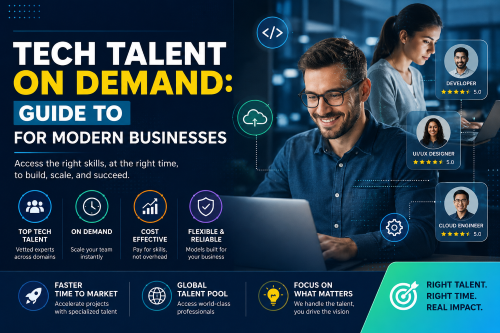
Enter the era of tech talent on demand: a hiring model where organizations access skilled technology professionals — developers, data scientists, cybersecurity experts, cloud architects, DevOps engineers, and more — exactly when they need them, for exactly as long as they need them, without the friction of conventional recruitment.
This shift isn’t a passing trend. It reflects a deeper transformation in how work itself is structured. Companies of every size, from early-stage startups to Fortune 500 enterprises, are embracing on-demand tech talent to stay competitive, control costs, and access specialized skills that may not exist within their permanent workforce. Providers like Risezen Tech have emerged to help businesses navigate this shift, connecting them with vetted technology professionals quickly and reliably. In this article, we’ll explore what tech talent on demand really means, why it matters, the models businesses use to access it, the benefits and challenges involved, and how organizations can build a strategy to make the most of this evolving talent landscape.
What Does “Tech Talent on Demand” Actually Mean?
At its core, tech talent on demand refers to the practice of sourcing technology professionals through flexible, non-traditional employment arrangements rather than exclusively through permanent, full-time hiring. This can include:
- Freelancers and independent contractors who work on a project basis
- Staff augmentation, where external professionals are embedded into an existing team temporarily
- Managed teams or pods from a technology talent provider who deliver a defined outcome
- Fractional experts, such as part-time CTOs or part-time security leads
- Talent marketplaces and platforms that connect businesses directly with vetted professionals
- Outsourced development shops that take on entire projects or products
The unifying idea is flexibility. Instead of committing to a long-term employment relationship before a single line of code is written, companies can bring in exactly the expertise they need, scale it up or down as priorities shift, and pay only for the value delivered.
This is a fundamental departure from how technology teams were built in the past. Historically, if a company needed a mobile app developer, a machine learning engineer, or a cloud security specialist, it had to go through a lengthy hiring process, often taking two to four months from job posting to offer acceptance. Today, that same expertise can potentially be engaged within days through on-demand talent channels.
Why Tech Talent on Demand Has Become So Important
Several converging forces have made on-demand tech talent not just attractive, but often essential.
1. The Accelerating Pace of Technology Change
Technology stacks evolve constantly. A company that built its infrastructure on a particular framework five years ago may now need expertise in cloud-native architecture, artificial intelligence integration, or advanced cybersecurity practices that didn’t exist — or weren’t mainstream — when their original team was hired. Rather than retraining an entire department or making risky long-term hires speculatively, businesses can bring in specialists with exactly the up-to-date skills required for a specific initiative.
2. The Global Talent Shortage in Technology
Across the world, demand for skilled technology professionals has consistently outpaced supply, particularly in high-growth areas like artificial intelligence, cybersecurity, cloud computing, and data engineering. Many organizations simply cannot find the right full-time candidates fast enough, if at all, in their local markets. On-demand talent models — especially those that tap into global or remote talent pools — offer a practical way to close this gap.
3. Project-Based and Cyclical Work
Not all technology work is ongoing. A company might need to:
- Build and launch a new product within six months
- Migrate legacy systems to the cloud
- Conduct a one-time security audit
- Scale up engineering capacity during a critical growth phase
- Handle a seasonal spike in platform traffic and infrastructure needs
For these kinds of defined, time-bound initiatives, hiring permanent staff can be inefficient. Once the project ends, the company may have more engineering capacity than it needs, leading to underutilized (and expensive) headcount. On-demand talent lets businesses match their workforce size to actual demand.
4. Cost Pressures and Budget Discipline
Full-time employees come with costs beyond salary: benefits, office space, equipment, training, payroll taxes, and the long-term financial commitment of severance or restructuring if business needs change. On-demand talent arrangements often allow companies to convert a fixed cost into a variable one, paying for expertise only when it’s actively being used.
5. The Rise of Remote and Distributed Work
The normalization of remote work has removed geographic barriers to hiring. A company in Chicago can now work seamlessly with a backend developer in Warsaw, a UX designer in Manila, and a data scientist in Bangalore. This globalization of the workforce has been a major enabler of on-demand talent models, since companies are no longer limited to the talent available within commuting distance of their offices.
6. Startups and Scale-Ups Need Speed
For startups, speed is often the difference between capturing a market opportunity and losing it to a competitor. Waiting months to hire a full engineering team can mean missing a critical launch window. On-demand talent allows lean teams to punch above their weight, assembling the right expertise quickly to build a minimum viable product, test an idea, or scale rapidly once product-market fit is found.
Common Models for Accessing Tech Talent on Demand
Businesses have several options when it comes to structuring on-demand tech talent relationships. Understanding the differences helps organizations choose the right approach for their specific needs.
Freelance and Independent Contractor Platforms
These platforms connect businesses directly with individual professionals who work independently, often on a project or hourly basis. This model works well for discrete, well-defined tasks — building a specific feature, fixing a bug, designing a landing page — where deep integration into a company’s internal team and culture isn’t essential.
Best suited for: Short-term, narrowly scoped projects; companies with strong internal project management capabilities.
Staff Augmentation
In this model, a business partners with a talent provider that supplies individual professionals who work as an extension of the internal team, often for months at a time. Unlike freelance platforms, staff augmentation typically involves closer collaboration, regular participation in team meetings, and integration into existing workflows and tools.
Best suited for: Companies that need to scale an existing team’s capacity without going through a full hiring cycle, especially when specialized skills (e.g., a specific cloud platform certification) are temporarily needed.
Managed Teams or Delivery Pods
Rather than supplying individual contractors, some providers offer a complete, self-managed team — including a project lead, developers, testers, and sometimes designers — who take ownership of an entire deliverable or product area. The client defines the outcome; the managed team handles execution.
Best suited for: Companies without in-house technical leadership for a specific initiative, or those looking to fully outsource a discrete product or project.
Fractional Executives and Specialists
Fractional roles — such as a fractional Chief Technology Officer, fractional security lead, or fractional data science advisor — allow companies to access senior-level strategic expertise on a part-time basis. This is particularly valuable for smaller companies that need high-level guidance but don’t yet have the budget or workload to justify a full-time executive hire.
Best suited for: Startups and small-to-midsize businesses needing strategic technical leadership without a full-time salary commitment.
On-Demand Talent Marketplaces with Vetting and Matching
A growing category of platforms goes beyond simple freelance listings by pre-vetting professionals for technical skill, communication ability, and reliability, then using algorithmic or human-assisted matching to connect them with businesses. These platforms often include additional layers of support, such as contract management, payment processing, and performance tracking.
Best suited for: Companies that want the speed of freelance hiring with a higher degree of quality assurance and reduced administrative burden.
Key Roles Businesses Source Through On-Demand Talent
While virtually any technical role can be sourced on demand, certain categories see especially high usage:
- Software developers (frontend, backend, full-stack, mobile) for building and maintaining applications
- DevOps and site reliability engineers for infrastructure automation and system uptime
- Data scientists and machine learning engineers for building predictive models and AI-driven features
- Cloud architects for designing and migrating infrastructure to platforms like AWS, Azure, or Google Cloud
- Cybersecurity specialists for penetration testing, compliance audits, and incident response
- UX/UI designers for product design and user research
- QA engineers and testers for quality assurance across development cycles
- Product managers for driving roadmap execution during critical growth phases
- Data engineers for building and maintaining data pipelines and warehouses
The Benefits of Tech Talent on Demand
Speed to Hire
Perhaps the most cited advantage is speed. Rather than waiting weeks or months to fill a role, businesses can often engage qualified professionals within days, particularly through vetted marketplaces or established staff augmentation partners.
Access to Specialized and Niche Skills
Certain technical skills — such as expertise in a specific programming language, a niche AI model architecture, or a particular compliance framework — may only be needed for a short period. On-demand talent allows businesses to access this expertise without committing to a permanent role that may become redundant once the specific need is met.
Scalability and Flexibility
Teams can expand or contract based on actual business needs. A company preparing for a major product launch might scale up its engineering capacity temporarily, then scale back down once the launch stabilizes, without the complications of layoffs or restructuring.
Cost Efficiency
By converting fixed labor costs into variable costs tied to actual project needs, businesses can often achieve better financial predictability and avoid the overhead associated with full-time employment, especially for short-term or fluctuating workloads.
Reduced Hiring Risk
Making a bad full-time hire is costly — not just financially, but in terms of team morale and lost time. On-demand engagements often allow for a “trial” period of working together before any longer-term commitment is considered, reducing the risk of a poor fit.
Access to Global Talent Pools
On-demand models, especially those built around remote work, allow companies to tap into talent pools far beyond their local geography, increasing both the quantity and diversity of available expertise.
Faster Innovation Cycles
With the ability to quickly assemble teams with the right skills, companies can move faster on new initiatives — testing ideas, building prototypes, and bringing products to market more quickly than they could relying solely on internal hiring timelines.
The Challenges and Risks to Consider
Tech talent on demand isn’t without its complications. Businesses need to be thoughtful about how they implement this model.
Integration and Culture Fit
External talent, particularly those engaged briefly or through freelance platforms, may struggle to fully understand a company’s internal culture, communication norms, and unwritten processes. This can create friction, especially on projects that require deep collaboration with internal stakeholders.
Knowledge Continuity
When on-demand professionals move on after a project ends, there’s a risk of losing institutional knowledge, especially if documentation practices are weak. Companies need strong processes for knowledge transfer to avoid becoming dependent on individuals who may not be available for future work.
Quality Variability
Not all on-demand talent sources offer the same level of vetting. Freelance platforms with minimal screening can expose companies to inconsistent quality, requiring more oversight and management than anticipated.
Security and Compliance Concerns
Bringing external professionals into sensitive systems and data environments requires careful attention to access controls, non-disclosure agreements, and compliance requirements — particularly in regulated industries like finance and healthcare.
Communication and Time Zone Challenges
When working with globally distributed talent, time zone differences and language or cultural communication styles can sometimes slow down collaboration if not managed proactively.
Legal and Classification Considerations
Depending on jurisdiction, misclassifying workers as independent contractors when they function more like employees can create legal and tax liabilities. Businesses need to understand local labor laws when engaging on-demand talent, particularly across international borders.
How to Build an Effective On-Demand Tech Talent Strategy
For businesses looking to make on-demand tech talent a core part of their workforce strategy — rather than a reactive stopgap — a more deliberate approach pays off.
1. Define Clear Scopes and Outcomes
On-demand engagements work best when the scope of work is clearly defined. Vague expectations lead to scope creep, mismatched deliverables, and frustration on both sides. Before engaging talent, clarify the specific outcomes, timelines, and success metrics for the engagement.
2. Choose the Right Model for the Need
Not every need calls for the same on-demand model. A single, well-defined task might be perfect for a freelance platform, while a complex, ongoing initiative might benefit more from staff augmentation or a managed team. Matching the model to the actual need reduces friction and improves outcomes.
3. Invest in Onboarding, Even for Short Engagements
Even short-term contributors benefit from a lightweight onboarding process: access to necessary tools, a clear point of contact, and a basic understanding of relevant processes. This investment pays off in faster ramp-up time and better quality work.
4. Prioritize Documentation
Because on-demand talent may not stay with the company long-term, strong documentation practices are essential. This ensures that knowledge isn’t lost when a contractor’s engagement ends and makes it easier to bring in new talent later if needed.
5. Build a Bench of Trusted Talent
Rather than starting from scratch every time a need arises, many companies build ongoing relationships with a pool of trusted freelancers, contractors, or agency partners they can call on repeatedly. This reduces onboarding time and improves consistency over multiple engagements.
6. Balance On-Demand Talent with Core Internal Teams
On-demand talent works best as a complement to a strong internal core team, not a full replacement for it. Core strategic functions, deep institutional knowledge, and long-term product ownership are often best served by permanent employees, while on-demand talent fills in gaps, handles surges, and brings in specialized expertise as needed.
7. Evaluate Providers and Platforms Carefully
Whether working with a freelance platform, a staff augmentation firm, or a managed services provider, it’s worth investing time to evaluate their vetting processes, past client feedback, and ability to deliver the specific type of talent your business needs.
The Future of Tech Talent on Demand
Several trends suggest that the on-demand talent model will continue to grow in importance:
- Artificial intelligence is reshaping how talent is matched: AI-powered platforms are increasingly capable of analyzing project requirements and matching them with the most suitable available professionals faster and more accurately than manual processes, reducing the time and effort required to find the right fit.
- The skills gap in emerging technologies will keep widening: As fields like generative AI, quantum computing, and advanced cybersecurity continue to evolve rapidly, the pool of professionals with deeply current expertise will remain limited relative to demand, making on-demand access to specialized skills increasingly valuable.
- Hybrid workforce models are becoming the norm: Rather than viewing on-demand talent as separate from a “real” workforce, more companies are building intentionally blended teams that combine permanent staff with flexible, on-demand contributors as a standard operating model rather than an exception.
- Talent platforms are maturing: Marketplaces and staffing providers are increasingly offering more sophisticated vetting, project management support, and compliance handling, reducing the friction and risk historically associated with engaging external talent.
- Global competition for skilled tech talent will intensify: As more companies embrace remote and distributed hiring, competition for top-tier professionals will increasingly be global rather than local, making it even more important for businesses to have flexible, responsive talent strategies.
Real-World Scenarios: When Companies Turn to On-Demand Tech Talent
To make the concept more concrete, it helps to look at the types of situations that typically push a business toward an on-demand talent strategy.
Scenario 1: The Startup Racing Toward Launch A seed-stage startup has secured funding and needs to build a working product within four months to demonstrate traction to investors. The founding team includes a strong product visionary but lacks deep engineering bandwidth. Rather than spending two months hiring a full-time CTO and engineering team, the startup engages a managed development pod to build the first version of the product, while beginning a slower, more deliberate search for permanent technical leadership in parallel.
Scenario 2: The Enterprise Undergoing Cloud Migration A large enterprise with a legacy on-premises infrastructure decides to migrate its systems to the cloud. This is a complex, time-bound project requiring specialized cloud architecture skills that don’t exist within the current IT team, and won’t be needed at the same intensity once the migration is complete.
Scenario 3: The Mid-Size Company Facing a Security Incident After a near-miss security incident, a mid-size company realizes it needs an in-depth security audit and improved incident response protocols, but doesn’t have the budget or ongoing need for a full-time Chief Information Security Officer.
Scenario 4: The E-Commerce Business Preparing for Seasonal Demand An online retailer knows that traffic and transaction volume will spike dramatically during a seasonal shopping period. To ensure systems can handle the load and to implement new features before the rush.
Frequently Asked Question
Is tech talent on demand only useful for short-term projects? No. While it’s especially well-suited to short-term and project-based work, many companies also use on-demand models for longer, ongoing needs — for example, a fractional technical advisor who works with a company for years on a part-time basis, or a staff augmentation arrangement that continues for the life of a product.
How is on-demand tech talent different from traditional outsourcing? Traditional outsourcing often refers to handing off an entire function or project to a third-party company, sometimes with limited visibility or control over how the work gets done.
Can on-demand talent work alongside a full-time internal team? Yes, and in most successful implementations, this is exactly how it works. On-demand professionals are often integrated into existing teams, participating in the same meetings, using the same tools, and collaborating closely with permanent staff, rather than operating as a fully separate unit.
What industries benefit most from tech talent on demand? While nearly every industry can benefit, sectors experiencing rapid technological change or cyclical demand — such as e-commerce, fintech, healthcare technology, SaaS, and digital media — tend to see particularly strong value from flexible talent models, given how often their technical needs shift.
How do companies ensure quality when hiring on-demand talent? Quality assurance typically comes from a combination of factors: choosing reputable platforms or providers with strong vetting processes, checking references and past work, starting with smaller trial engagements before committing to larger projects, and maintaining clear communication and performance expectations throughout the engagement.
Conclusion
Tech talent on demand represents a fundamental shift in how businesses build and manage their technology capabilities. It’s a response to a world where technology changes quickly, specialized skills are scarce, project needs are often cyclical, and speed frequently determines competitive advantage.
For businesses willing to invest in the right strategy — choosing appropriate models, defining clear scopes, documenting knowledge, and balancing flexible talent with a strong internal core — on-demand tech talent offers a powerful way to stay agile, access world-class expertise, and execute on ambitious goals without the constraints of traditional hiring timelines.
As the technology talent landscape continues to evolve, the companies that thrive will likely be those that treat their workforce not as a fixed structure, but as a flexible, adaptable system — one capable of scaling expertise up or down exactly when and where it’s needed most. Tech talent on demand isn’t just a hiring tactic; it’s becoming a foundational part of how modern, competitive organizations operate. Partners such as Risezen Tech are helping to make this transition easier, giving businesses a reliable way to access the right technology talent, right when they need it.
