

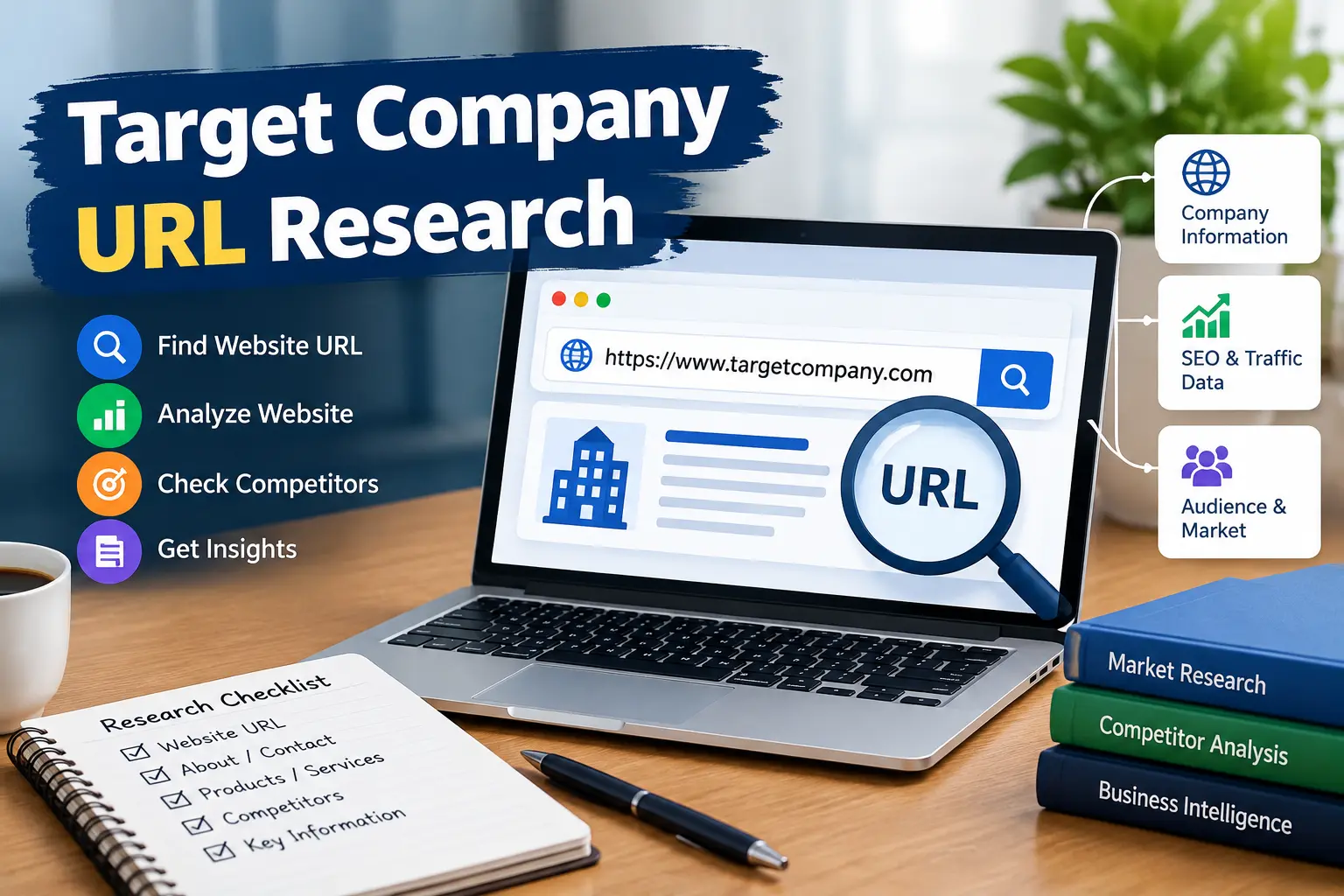
If you have ever stared at a spreadsheet with five hundred company names in column A and an empty column B waiting for “website,” you already understand why target company URL research has become its own discipline inside sales, recruiting, marketing, and operations teams. What looks like a five-minute task for one company name quietly turns into a multi-day project once the list grows past a hundred rows, once names get abbreviated, once three different companies share almost the same name, and once someone downstream starts sending outreach emails to the wrong domain.
This guide walks through what target company URL research actually is, why it has become a genuine operational bottleneck for growing teams, the manual process for doing it correctly, the tools that automate the repetitive parts, and the verification habits that separate a clean, trustworthy company dataset from one quietly full of mismatched records. Whether you are an SDR building a prospect list, a recruiter confirming an employer before an outreach message, a market analyst mapping a category, or an operations lead cleaning up a CRM, the fundamentals below apply to you.
What Is Target Company URL Research?
In plain terms, target company URL research is the process of taking a company name — often just plain text sitting in a spreadsheet, a CRM field, or a resume — and finding that company’s correct, official, currently active website address.
The phrase “target company” is a standard business term, not a reference to any single retailer. It simply means any company that a researcher, salesperson, recruiter, investor, or analyst is currently investigating, prospecting, or planning to approach. A “target list” is the list of companies your team has decided are worth pursuing, whether that means selling to them, recruiting from them, studying them, or partnering with them.
The “URL” part is the part that trips people up at scale. Every company on the internet has what amounts to a home address, and that home address is called a URL — short for Uniform Resource Locator, though almost nobody outside of engineering calls it that. Most people just say “website address” or “domain.” Apple’s is apple.com. Coca-Cola’s is coca-cola.com. Type either into a browser and it takes you straight to the company’s official presence. That sounds trivial for household names, and it is. It stops being trivial the moment your list includes regional distributors, private manufacturers, three-person startups, and companies that share a name with a much larger, unrelated organization in a different country.
So target company URL research, at its core, is the bridge between “a company name I have” and “the verified domain I can actually use” — in outreach sequences, CRM records, competitive research, recruiting pipelines, and due-diligence reports.
Why Target Company URL Research Matters More Than It Looks Like It Should
On the surface, finding a website feels like a solved problem. Everyone has typed a company name into a search engine and clicked the first blue link. The trouble starts when that casual habit gets applied at volume, and when the cost of being wrong is higher than a wasted thirty seconds.
Sales and SDR Teams
Sales development teams build prospect lists before any outreach happens. A verified domain is often the single piece of data that unlocks everything else — company size lookups, technographic data, email pattern guessing, LinkedIn company page matching, and CRM deduplication all key off the domain, not the company name. Send a sequence of cold emails to the wrong domain, or import a mismatched company record into a CRM, and a rep can burn hours before anyone notices the account details belong to an entirely different business.
Recruiters and Talent Sourcing
Recruiters frequently work from resume databases, referral lists, or LinkedIn exports where the “current company” field is a free-text name with no attached website. Before reaching out to a candidate about a role, or before confirming that a candidate’s stated employer is real and current, recruiters need the verified domain — partly to find the careers page, and partly to make sure they are not accidentally reaching out about the wrong “Summit Solutions” or the wrong “Apex Group.”
Marketing, SEO, and Partnerships Teams
Marketing and SEO teams lean on target company URL research for competitor analysis, backlink research, and partnership vetting. If a brand list is being checked for co-marketing opportunities, the analysis is only as good as the underlying domain data. A single incorrect domain in a competitor set can distort an entire report.
Market Researchers and Analysts
Anyone mapping “who operates in this category” needs a reliable way to move from a list of company names — often scraped, self-reported, or manually compiled — to a list of verified, deduplicated websites. Bulk lookup saves the researcher from running the same manual search dozens or hundreds of times.
Operations and Data Teams
Every CRM eventually accumulates company records that were entered inconsistently over months or years by different people typing company names from memory, from business cards, or from email signatures. Someone eventually has to go back and confirm the URLs are correct, because a CRM full of mismatched company records slowly undermines every report, forecast, and territory assignment built on top of it.
The common thread across every one of these roles: getting the URL wrong is not a cosmetic error. It propagates. A wrong domain in a CRM becomes a wrong domain in an email sequence, a wrong domain in a reporting dashboard, and eventually a wrong domain in a board deck.
The Core Challenge: Company Names Are a Terrible Identifier
Company names are convenient for humans and unreliable for systems. They repeat across regions. They get abbreviated inconsistently — “International Business Machines,” “IBM,” and “I.B.M.” might appear as three different strings in three different source lists, all referring to the same organization. Companies rebrand. Companies get acquired and absorbed into a parent brand. And critically, unrelated companies frequently share the same or a very similar name, especially once you cross borders.
A generic name like “Summit Solutions Ltd.” might refer to a small consultancy in London, an unrelated software vendor in Toronto, and a manufacturing firm in Singapore — three different companies, three different domains, one shared name. Selecting the first search result for a name like that creates a real risk of attaching the wrong website, and therefore the wrong company data, to your target record.
This is exactly why serious business research increasingly treats a registration number — where available — as the more reliable identifier, and treats the company name as a starting point rather than a final answer. Names are what a human types into a search box. Registration numbers, and by extension domains, are what a system can actually trust.
Standardizing Your Source List Before You Start
Before any searching happens, the raw list of company names benefits from a standardization pass. This step gets skipped constantly, and it is the single easiest way to improve match accuracy without doing any extra “real” research.
A few habits make a measurable difference:
- Remove duplicates and blank rows. A list with repeated or empty entries wastes lookup effort and pollutes downstream reporting.
- Strip inconsistent legal suffixes where possible, or at least normalize them (“Inc.”, “Ltd.”, “LLC”, “GmbH”) so that matching logic and human reviewers aren’t thrown off by formatting differences alone.
- One company name per line, cleanly separated from any other data (titles, addresses, notes) that might have been pasted in alongside it.
- Flag obviously incomplete entries — a single word, an acronym with no context, or a name that’s actually a person’s name — for manual review before running them through any automated matching process.
Teams that skip this step tend to see their automated match confidence scores drop across the board, not because the tool is unreliable, but because messy input produces messy output. Standardizing first is the cheapest accuracy improvement available in the entire workflow.
The Manual Method: How to Do Target Company URL Research by Hand
For a small list — a handful of companies, or an occasional one-off lookup — doing target company URL research manually is completely reasonable. Here is a dependable step-by-step approach.
Step 1: Search the Full, Exact Company Name
Start with a search engine query using the complete, exact company name, including its legal suffix if you have it. Adding a distinguishing detail — an industry, a city, or a country — narrows the results significantly when the name is generic.
Step 2: Identify the Official Domain, Not a Directory Listing
Search results are often dominated by directory sites, review aggregators, LinkedIn company pages, and news mentions before the company’s actual homepage appears. The official domain is usually recognizable by a few signals: it matches the company’s branding, it has an “About,” “Contact,” or “Careers” page consistent with the company described in your source data, and it is not hosted on a third-party platform unless the company genuinely is a small business running solely off a marketplace or social page.
Step 3: Cross-Check With a Second, Independent Source
A single search result is not verification — it’s a hypothesis. Cross-check the candidate domain against a second, independent source: the company’s LinkedIn page (which usually lists a website field), a business registry filing, or a press release that names the domain directly. When two independent sources agree on the same domain, confidence goes up substantially.
Step 4: Confirm the Domain Is Currently Active and Correctly Owned
A domain can be correct in spirit but wrong in practice — expired, parked, redirected to an unrelated buyer, or sitting under a different subsidiary than the one you’re researching. A quick WHOIS or RDAP lookup (the modern, standardized replacement for WHOIS) can confirm registration details and flag anything that looks off, such as a very recent registration date for a company that claims decades of history.
Step 5: Record the Registrable Domain, Not Every Subdomain
For most target company URL research projects, the registrable domain — the root domain like “example.com,” as opposed to “shop.example.com” or “careers.example.com” — is the most useful company-level identifier. Treating every subdomain as a separate organization creates messy, fragmented company matching further down the pipeline. Standardize on the registrable domain as the canonical identifier, and note subdomains separately if you need them for a specific purpose, like a careers page finder.
Doing this manually for ten or twenty companies is a reasonable afternoon task. Doing it manually for five hundred companies, especially when a meaningful fraction of those names are ambiguous or generic, is where teams start looking for a faster path.
Automating the Repetitive Part: Bulk URL Lookup Tools
This is where automated target company URL research tools earn their place in the workflow. The mechanics are straightforward: you paste a list of company names, the tool searches for likely matches, and it returns each company’s probable official domain alongside a name-match confidence score.
A well-built tool in this category typically offers a few core capabilities:
- Bulk lookup from a pasted list, so a spreadsheet of hundreds of names can be processed in one pass instead of one search at a time.
- A confidence or match score for each result, giving the reviewer a fast signal for which rows need a manual second look and which are safe to trust.
- CSV export with the company name, matched URL, and confidence score together, so the output drops directly into a CRM import, a spreadsheet, or a reporting tool.
- Industry or geography discovery features, useful for building a target list from scratch rather than starting from an existing one — for example, browsing companies by sector for account-based marketing research.
- A careers-page finder, which is particularly useful for recruiters who need the specific subdomain or URL pattern a company uses for job listings, without manually clicking through every homepage.
Automated tools are genuinely good at the first ninety percent of the problem: turning a large, mostly-clean list into a set of high-confidence matches quickly. Where they need a human in the loop is the ambiguous tail — companies with generic names, companies that recently rebranded, and companies where multiple similarly-named organizations exist. Treating an automated match as a strong starting point, rather than a guaranteed final answer, is the difference between a dataset you can trust and one with quiet, compounding errors.
Verification: Moving From “Probably Right” to “Confirmed”
For anything beyond casual research — sales outreach at scale, recruiting decisions, investment due diligence, or ongoing CRM hygiene — verification deserves its own step, separate from the initial lookup. A handful of source types carry meaningfully more evidentiary weight than others, and it’s worth understanding the hierarchy.
Official filings and regulators sit at the top. A business registration record, a securities filing, or a government business registry entry that explicitly lists a company’s website is about as strong as evidence gets, because it comes from a source with a legal obligation to be accurate.
First-party company pages — the company’s own “Contact,” “Legal,” or “Privacy Policy” pages, which often restate the registered company name and sometimes the registration number — are strong secondary evidence, especially when they’re internally consistent with what you already know about the company.
Established professional platforms, like a company’s official LinkedIn page, carry reasonable weight, particularly when the page has an established history, a plausible employee count, and activity consistent with a real, active business.
Scraped directories and aggregator sites sit much lower on the trust hierarchy. A directory listing that simply copied a name-and-website pair from another database is not independent evidence.
A few additional technical checks round out a rigorous verification pass:
- RDAP or WHOIS lookups confirm domain registration details, registrant organization (when not privacy-shielded), and registration date — useful for catching domains that don’t match the company’s claimed history or ownership.
- LEI (Legal Entity Identifier) lookups, where available, tie a company to a globally standardized identifier used in financial and regulatory contexts, which can help disambiguate companies with identical or near-identical names.
- SSL certificate details on a candidate domain sometimes list the registered organization name directly, which is a fast, easy corroborating signal.
Building a Repeatable Process, Not a One-Time Cleanup
A one-time research project — verifying domains for a fixed list of fifty companies for a single report — is straightforward to handle manually or with a single automated pass. The situation changes for anything ongoing: continuous sales prospecting, an actively growing CRM, or a recruiting pipeline that never stops adding new employer names.
For ongoing work, target company URL research benefits from becoming a documented, repeatable process rather than a recurring emergency cleanup project. A few elements make that process durable:
- A standard naming convention for how company names get entered into the source system in the first place, reducing the number of inconsistent variants that need reconciling later.
- A defined confidence threshold below which a match always triggers manual review, so low-confidence guesses never silently enter the CRM as if they were verified facts.
- A periodic re-verification pass, because companies rebrand, merge, get acquired, or shut down over time, and a domain that was correct a year ago is not guaranteed to still be correct today.
- Clear ownership — someone on the team responsible for the accuracy of the company-to-domain mapping, rather than treating it as everyone’s job and therefore no one’s job.
Treating URL verification as ongoing maintenance, the same way a team treats data backups or security patching, keeps a growing company database from slowly degrading in accuracy as the underlying business landscape shifts underneath it.
Getting the Data Where It Needs to Go
Once a list of verified company domains exists, the practical next step is getting that data into the systems where it will actually be used. Most bulk research tools export results as a CSV containing the company name, matched URL, and confidence score, sometimes alongside a logo or basic industry tag. That format drops directly into Salesforce, HubSpot, Apollo, or effectively any CRM or sales engagement platform that accepts CSV imports.
A workflow that tends to work well in practice looks like this: export the raw, verified domain list first, run it through whatever data enrichment provider your team uses for firmographic detail — company size, revenue, technographic data, or contact information — and only then import the fully enriched records into the CRM. Trying to enrich unverified, possibly mismatched domains first just means paying for enrichment data attached to the wrong company.
It’s also worth being clear-eyed about what a URL research tool is, and isn’t, meant to do. Finding and verifying the correct official domain is a distinct task from enrichment — pulling company size, revenue, or contact emails. A tool built specifically for URL lookup and verification generally will not, and should not, try to be an all-in-one enrichment platform. Pairing a dedicated URL research step with a dedicated enrichment provider downstream tends to produce cleaner results than expecting one tool to do both jobs well.
Common Mistakes That Quietly Damage a Company Dataset
A few mistakes show up again and again across teams doing this kind of research, and each one is avoidable once it’s named explicitly.
- Trusting the first search result without cross-checking: The first organic result for a generic company name is frequently a directory listing, a news article, or an unrelated company with a similar name — not the company’s actual homepage.
- Treating every subdomain as a separate company: Recording “shop.example.com,” “blog.example.com,” and “example.com” as three unrelated entities fragments what should be a single company record and breaks deduplication logic downstream.
- Skipping the second source: A single piece of evidence, however plausible, is a hypothesis. Two independent sources agreeing is genuine verification.
- Ignoring low confidence scores because a list is large: It’s tempting to accept every result from an automated tool when a list runs into the hundreds, but the low-confidence tail is exactly where the real errors concentrate. A five-minute manual review of the bottom ten percent of matches by confidence score catches a disproportionate share of the mistakes.
- Never re-verifying: Domains that were correct at the time of the last CRM cleanup silently go stale as companies rebrand, get acquired, or shut down, and nothing flags that decay unless a re-verification pass is scheduled.
- Conflating a company name with a unique identifier: As covered earlier, company names repeat. Wherever a registration number, LEI, or other unique identifier is available, it belongs in the record alongside the domain, not instead of the domain, because it’s the piece that actually disambiguates similarly named companies.
Using Target Company URL Research for Account-Based Marketing and List Building
So far this guide has assumed a starting point: a list of company names that already exists, needing to be matched to domains. But a large share of target company URL research actually starts earlier in the funnel, before any list exists at all — with a team trying to build a target list from scratch based on an Ideal Customer Profile (ICP).
For Account-Based Marketing (ABM) campaigns in particular, the workflow tends to run in the opposite direction from straight URL lookup. Instead of starting with names and finding domains, ABM teams often start with criteria — an industry, a company size range, a geography — and need to discover which companies actually fit before any domain matching happens.
A useful pattern here is to separate discovery from verification as two distinct phases. In the discovery phase, teams browse a curated directory or dataset organized by industry and region to identify companies that plausibly fit their ICP — technology companies in a specific metro area, fintech companies of a certain size, manufacturers within a target vertical. This phase produces a candidate list, not a verified one. In the verification phase, that candidate list then goes through the same standardize-match-verify process described earlier in this guide, producing a clean, domain-verified target list ready for outreach or campaign targeting.
Combining geography-based discovery with domain verification is particularly useful for regional ABM campaigns, where a marketing team needs to confirm not just that a company exists and fits the ICP, but that outreach can actually reach the right domain, the right regional office, and — where relevant — the right careers or contact page for that specific market.
Using Hiring Activity as a Buying Signal
One underused technique worth mentioning: once a verified target list exists, hiring activity on each company’s careers page can serve as a practical buying signal, particularly for B2B software and services companies. A company actively hiring for sales, marketing, or operations roles is frequently a company that’s growing and therefore has budget to spend — which makes it a reasonable candidate to prioritize higher in an outreach sequence than a company showing no hiring activity at all.
This is where a careers-page finder, paired with the verified domain from the earlier research phase, becomes genuinely useful rather than a nice-to-have. Instead of manually visiting each company’s website and hunting for a jobs or careers link — which varies wildly in URL pattern from company to company — a tool that can predict or locate the common careers-page pattern for a verified domain saves meaningful time across a list of any real size. The practical sequence looks like this: verify the domain first, then check hiring signals on that verified domain, and only then prioritize outreach based on which accounts show active growth signals.
Frequently Asked Questions
What does “target company” mean in this context?
It’s a general business term for any company being researched, prospected, or evaluated — it has no connection to any specific retailer or brand that happens to share the word “target” in its name.
Is target company URL research the same as company data enrichment?
No. URL research is specifically about finding and verifying the correct official website for a company. Enrichment is a separate, downstream step that adds details like company size, revenue, industry classification, or contact information, typically using the verified domain as the key.
How accurate are automated bulk lookup tools?
Well-built tools handle the clear majority of straightforward company names with high accuracy, particularly for well-known or uniquely named companies. Accuracy drops for generic names, very small companies, and companies with multiple similarly named counterparts elsewhere in the world — which is exactly why a confidence score and a manual review step for low-confidence matches matter.
What’s the registrable domain, and why does it matter?
The registrable domain is the root domain of a website — “example.com” rather than “careers.example.com” or “shop.example.com.” Using it consistently as the company-level identifier avoids fragmenting a single company into multiple records across different systems.
Final Thoughts
Target company URL research looks deceptively simple from a distance — paste a name, find a website, move on. At small scale, it genuinely is that simple. The complexity shows up at volume, when messy source data, generic company names, and the sheer number of lookups required turn a five-minute task into a recurring operational burden.
The teams that handle it well share a common pattern: they standardize their source data before searching, they treat automated matches as a strong starting point rather than a finished answer, they weight their evidence sources deliberately instead of trusting the first search result, and they build re-verification into their ongoing process instead of treating URL accuracy as a one-time cleanup. Whether the list in front of you has ten companies or ten thousand, that same discipline — standardize, match, verify, maintain — is what turns a spreadsheet of company names into a dataset your sales, recruiting, or research team can actually rely on.
