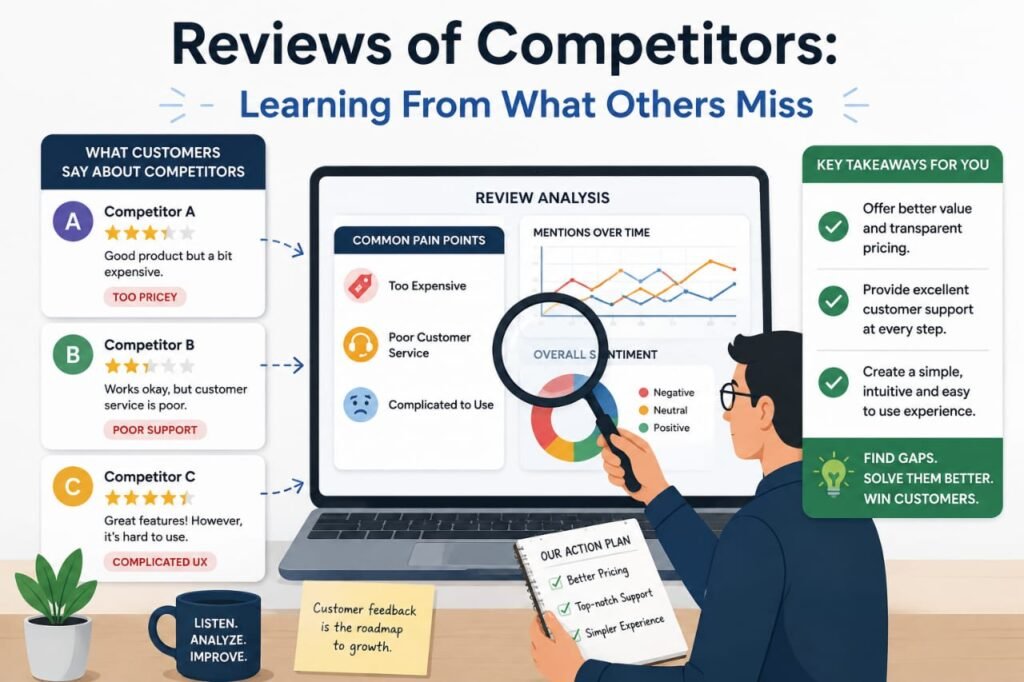
Every business has competitors. Every competitor has customers. And every customer leaves a trail of feedback. That trail is gold. It sits in reviews of competitors, waiting to be read.
Most businesses ignore it. They check their own reviews. They rarely check anyone else’s. That’s a mistake. Reviews of competitors tell you what people love. They tell you what people hate. They tell you exactly where the market has a gap.
This guide walks through everything you need to know. We’ll cover why reviews of competitors matter. We’ll show you where to find them. And We’ll explain how to read them the right way. And we’ll turn all of that into real action steps for your business.
Why Reviews of Competitors Matter
Reviews of competitors are not gossip. They are data. Real customers write them. They describe real experiences. Good or bad, the words are honest.
Most people trust online reviews. Many won’t buy without reading them first. That means reviews of competitors shape buying decisions every single day. If you ignore them, you’re ignoring a huge part of the market conversation.
Here’s the simple truth: your competitors are already talking to your future customers. Through their products. Through their support teams. And Through their pricing pages. And those customers are talking back, in public, through reviews.
Reviews of competitors let you listen in. You get to hear the complaints before you ever launch a product. You get to hear the praise before you ever write a marketing page. That’s a huge head start.
They Reveal Weak Spots
Every business has weak spots. Slow shipping. Confusing pricing. Poor support. Reviews of competitors expose these weak spots in plain language.
Customers rarely hold back in a review. They say exactly what frustrated them. They say it clearly. This gives you a map of pain points across your whole industry.
If you see the same complaint again and again, pay attention. That complaint is a pattern, not a one-off. Patterns point to real problems. Real problems are opportunities.
They Reveal Strengths Too
Not every review is negative. Many are glowing. Reviews of competitors also show what people love.
Maybe customers praise a simple checkout process. Maybe they love fast replies from support. And Maybe they mention a specific feature again and again. These strengths tell you what actually matters to buyers.
Don’t skip the five-star reviews. They matter just as much as the one-star ones. Sometimes more.
They Show You the Exact Words Customers Use
Reviews of competitors are written by real people, in real language. Not marketing language. Real language.
This matters more than it sounds. If customers keep describing a problem as “confusing setup,” that phrase is useful. Use it in your own copy. Speak the way your audience already speaks.
Marketing teams spend hours guessing at customer language. Reviews of competitors hand it to you for free.
Where to Find Reviews of Competitors
Reviews of competitors live in many places. Some are obvious. Some get overlooked. Here’s a rundown of where to look.
General Review Platforms
Google Reviews is the biggest and most trusted source. Most local and many online businesses have a listing here. Start your search there.
Trustpilot is popular for online businesses, especially in retail and services. Reviews here tend to be detailed.
Yelp still matters for local businesses, especially restaurants, salons, and other service providers.
Software and B2B Platforms
If your competitors sell software, check G2 and Capterra. These platforms attract detailed, feature-level reviews from real users. B2B buyers rely on them heavily.
Marketplace Reviews
If your competitors sell physical products, check Amazon reviews. They’re detailed, high in volume, and brutally honest. App stores work the same way for mobile apps. Check the Apple App Store and Google Play.
Social Media and Forums
Reviews of competitors aren’t limited to formal review sites. Twitter, Reddit, and Facebook groups are full of unstructured feedback. It’s messier, but often more candid.
Search competitor brand names alongside words like “worst,” “disappointed,” or “love.” You’ll find real conversations happening in the open.
Glassdoor
Don’t forget employee reviews. Glassdoor shows you what it’s like to work at a competitor. This can reveal internal problems that eventually show up in customer service too.
How to Read Reviews of Competitors the Right Way
Finding reviews of competitors is step one. Reading them well is step two. Most people skim. Skimming misses the good stuff.
Start With the Extremes
Read the one-star reviews first. Then read the five-star reviews. The middle reviews are often vague. The extremes are honest and detailed.
One-star reviews of competitors show you exactly what breaks trust. Five-star reviews show you exactly what builds it.
Look for Repeated Themes
A single complaint might be a fluke. Ten complaints about the same thing is a pattern. Track recurring themes across dozens of reviews of competitors. Group them by topic:
- Product quality
- Customer service
- Pricing
- Shipping and delivery
- Ease of use
- Communication
This turns a pile of scattered comments into a clear picture.
Pay Attention to Tone, Not Just Words
Sometimes the words are polite, but the tone is frustrated. Read between the lines. A review that says “it works, I guess” is not really a happy review. Tone tells you more than the surface words sometimes suggest.
Check the Dates
Old reviews might describe problems that are already fixed. New reviews of competitors show current reality. Always sort by recent first. A company might have improved. Or gotten worse. You want the current story, not last year’s story.
Don’t Take One Review as Gospel
Context matters. A single angry review might come from an unusual situation. Maybe the customer had unrealistic expectations. Maybe it was a rare mistake.
Look for the same complaint across multiple reviews of competitors before treating it as a real pattern. One data point isn’t a trend. Ten data points might be.
Turning Reviews of Competitors Into Action
Reading reviews is only useful if you act on them. Here’s how to turn insight into strategy.
Fix the Gaps Competitors Leave Open
If reviews of competitors show slow support as a common complaint, make fast support your selling point. If shipping delays keep coming up, promise and deliver faster shipping.
You don’t need to guess what matters to customers. Reviews of competitors already told you.
Borrow the Praise, Not the Product
Don’t copy a competitor’s product feature by feature. Instead, ask why customers love that feature. Maybe it’s not the feature itself. Maybe it’s the outcome: less stress, more time saved, more confidence.
Build toward that outcome in your own way. Reviews of competitors show the “why” behind customer loyalty, not just the “what.”
Update Your Marketing Language
Take the exact phrases customers use in reviews of competitors. Not to copy them word for word, but to understand the tone and priorities behind them. Then reflect that language, in your own voice, across your website and ads.
If people describe a problem as “constant back and forth with support,” and your product solves that, say so clearly. Speak their language.
Train Your Team on Common Failures
Share review insights with your support and product teams. If reviews of competitors reveal that billing confusion is common industry-wide, audit your own billing process before it becomes your problem too.
Prevention is cheaper than damage control.
Watch for Trends Over Time
Reviews of competitors change over time. A company might launch a new product and reviews shift. A company might cut support staff and reviews turn negative fast.
Set a regular schedule. Check monthly or quarterly. Treat it like ongoing research, not a one-time project.
Tools That Make This Easier
Reading reviews manually works, but it takes time. Several tools can speed up the process.
Review aggregators pull reviews of competitors from multiple platforms into one dashboard. This saves hours of manual searching.
Sentiment analysis tools scan large volumes of reviews of competitors and group them by positive, negative, or neutral tone. This helps you spot patterns fast.
Alert tools notify you when new reviews of competitors appear. This keeps your research current without daily manual checks.
Fake review detectors help filter out manipulated or paid reviews of competitors, so your data stays accurate.
None of these tools replace human judgment. But they save time on the collection side, so you can spend more time on analysis.
Common Mistakes to Avoid
Even with good intentions, businesses often get this wrong. Here are the most common mistakes.
Only Checking One Platform
Different platforms attract different customers. Google Reviews skews toward general consumers. G2 skews toward professional buyers. Relying on just one source gives you a narrow, incomplete view. Check multiple platforms for a fuller picture.
Ignoring Small or Indirect Competitors
Big-name competitors aren’t the only source of insight. Smaller or indirect competitors often reveal fresh ideas and overlooked customer needs. Don’t skip them just because they’re less well known.
Treating Every Complaint as Urgent
Not every complaint deserves an immediate reaction. Some are rare edge cases. Focus energy on patterns, not isolated incidents.
Copying Instead of Learning
The goal isn’t to copy a competitor’s product or messaging outright. It’s to understand customer needs and build a better response, in your own way.
Forgetting Your Own Reviews
While studying reviews of competitors, don’t lose sight of your own. Compare both side by side. This shows you where you’re already ahead, and where you still need work.
A Simple Framework You Can Use Today
Here’s a short framework to make this practical.
Step 1: Pick your competitors: List 3 to 5 direct competitors and 2 to 3 indirect ones.
Step 2: Collect reviews: Pull reviews of competitors from Google, Trustpilot, G2, Amazon, or app stores, depending on your industry.
Step 3: Sort by rating: Separate one-star, five-star, and everything in between.
Step 4: Tag themes: Group comments into categories like pricing, support, quality, and delivery.
Step 5: Spot patterns: Highlight the issues and praises that repeat across many reviews of competitors.
Step 6: Take one action: Pick one clear improvement or messaging change based on what you found.
Step 7: Repeat regularly: Set a monthly or quarterly reminder to redo this process.
This framework turns a vague idea like “check competitor reviews” into a repeatable habit.
Frequently Asked Questions
Is it ethical to read reviews of competitors? Yes. Reviews are public information, written by real customers. Reading them is a normal part of market research. Just avoid unethical practices, like posting fake reviews yourself or impersonating customers.
How often should I check reviews of competitors? Monthly is a good starting point for fast-moving industries. Quarterly works for slower ones. The key is consistency, not frequency.
What if a competitor has very few reviews? Look at multiple platforms. Combine what little data exists with reviews of similar or indirect competitors to fill the gap.
Can reviews of competitors help with pricing decisions? Yes. Complaints about pricing being too high or unclear can guide how you structure and explain your own pricing.
Should I respond to reviews of my competitors? No. Focus your energy on your own reviews and your own customer relationships. Use competitor reviews strictly for internal research.
Final Thoughts
Reviews of competitors are one of the most underused resources in business. They’re free. They’re honest. And they’re sitting in plain sight, waiting to be read.
Customers already told your competitors what they want. Now you get to listen too. Use that information to close gaps, sharpen your messaging, and build something people genuinely prefer.
Start small. Pick one competitor. Read twenty reviews. Look for patterns. That one habit, repeated over time, can shape smarter decisions across your entire business.
Reviews of competitors won’t just show you what others are doing wrong. They’ll show you exactly where you can do better.