Cricket is a game filled with rules, strategies, and technical details that make it unique from other sports. While fans often focus on boundaries, wickets, and match-winning performances, the markings on the pitch are equally important. Among these markings, cricket creases play a vital role in determining whether a batsman is safe, a bowler has delivered legally, or a wicket has been taken fairly.
Many new cricket fans often ask: How many creases are there in cricket?
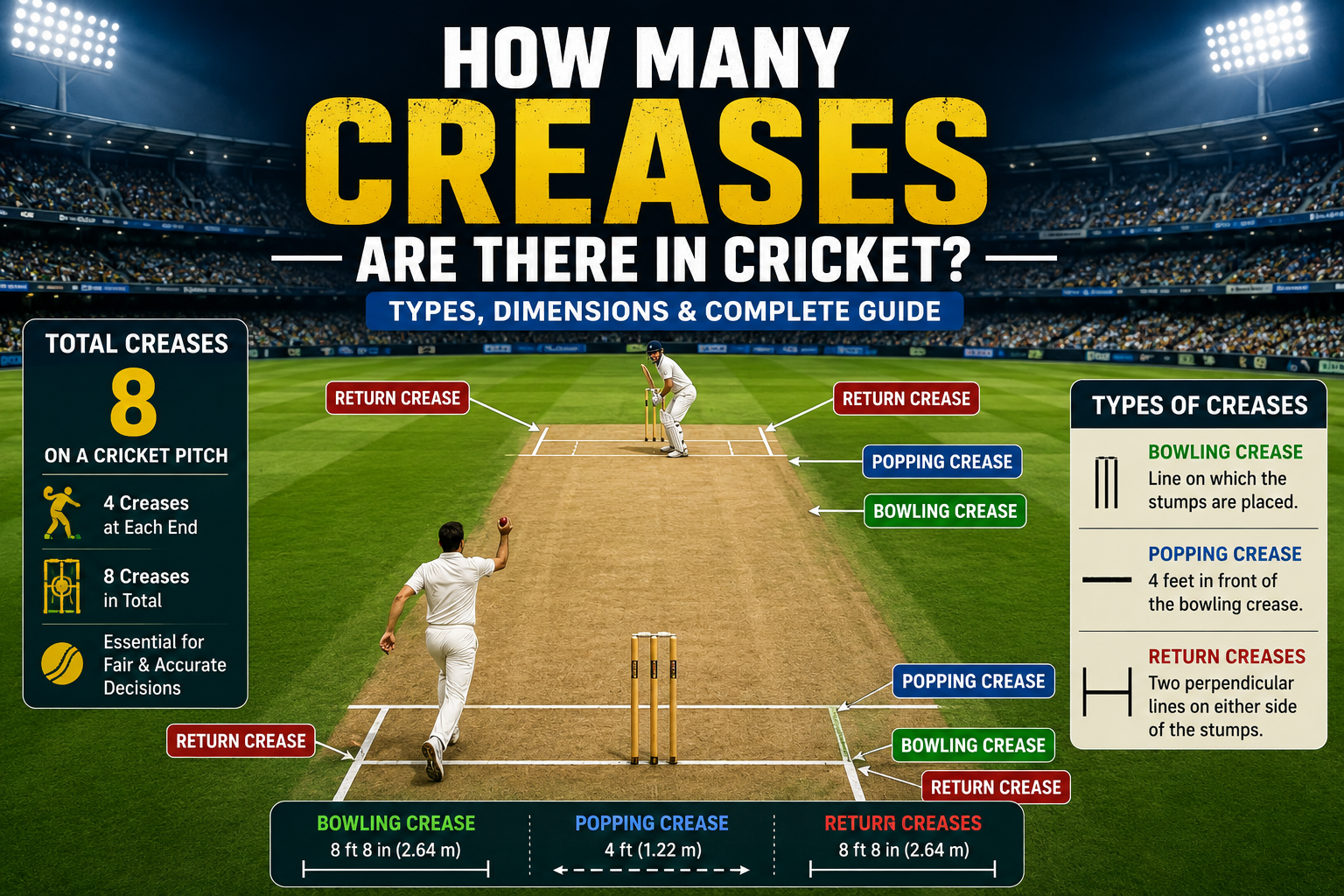
The answer is simple: There are four creases at each end of the cricket pitch, making a total of eight creases on the entire pitch.
These creases are not just painted lines. They are essential reference points used by batsmen, bowlers, umpires, and even modern technology systems to make crucial decisions during a match.
In this guide, we’ll explore the different types of cricket creases, their dimensions, purpose, and why they are among the most important markings on a cricket field.
What Is a Cricket Crease?
A cricket crease is a line marked on the pitch that helps define specific areas for batsmen and bowlers. These lines are used to enforce the Laws of Cricket and assist umpires in making accurate decisions.
Every end of a cricket pitch contains four crease markings:
- One Bowling Crease
- One Popping Crease
- Two Return Creases
Since a cricket pitch has two ends, the total number of creases on a standard pitch is eight.
Without these markings, rules relating to run-outs, stumpings, no-balls, and legal deliveries would be difficult to apply consistently.
Check This :- How Many Creases Are There in Cricket? A Complete Detailed Guide
How Many Creases Are There in Cricket?
A standard cricket pitch contains:
| Type of Crease | Number at Each End | Total on Pitch |
|---|---|---|
| Bowling Crease | 1 | 2 |
| Popping Crease | 1 | 2 |
| Return Creases | 2 | 4 |
| Total | 4 | 8 |
Therefore, a cricket pitch has eight creases in total.
Each crease serves a different purpose and contributes to the smooth functioning of the game.
Types of Creases in Cricket
1. Bowling Crease
The bowling crease is the horizontal line on which the stumps are positioned.
Dimensions
- Length: 8 feet 8 inches (2.64 metres)
- Located directly under the stumps
- Acts as the primary reference point for all other pitch measurements
The three stumps are placed in the centre of the bowling crease, making it one of the most important markings on the pitch.
Why Is the Bowling Crease Important?
The bowling crease helps determine:
- Correct placement of stumps
- Pitch measurements
- Positioning of other crease lines
- Reference points for umpires
Although fans rarely focus on it during a match, the bowling crease forms the foundation of the entire pitch layout.
2. Popping Crease
The popping crease is the most commonly discussed crease in cricket because it directly affects batsmen and bowlers.
It is drawn parallel to the bowling crease and positioned in front of it.
Dimensions
- Located 4 feet (1.22 metres) in front of the bowling crease
- Extends beyond both return creases
- Runs across the width of the pitch
Why Is the Popping Crease Important?
The popping crease is used to determine:
- Run-outs
- Stumpings
- Front-foot no-balls
- Whether a batsman has made their ground
A batsman is generally considered safe if some part of their body or bat is grounded behind the popping crease when the wicket is broken.
This is why players often stretch their bats desperately toward the crease during close run-out situations.
3. Return Creases
Return creases are vertical lines marked at right angles to the bowling crease.
There are two return creases at each end of the pitch.
Dimensions
- One on each side of the stumps
- Perpendicular to the bowling crease
- Distance between the two return creases is 8 feet 8 inches (2.64 metres)
Why Are Return Creases Important?
Return creases are mainly used to judge whether a bowler has delivered the ball legally.
They help umpires determine:
- Back-foot no-balls
- Legal bowling position
- Delivery alignment
If a bowler’s back foot lands outside the return crease during delivery, the umpire may call a no-ball.
Layout of Cricket Creases
At each end of the pitch, the crease arrangement consists of:
✓ One Bowling Crease
✓ One Popping Crease
✓ Two Return Creases
The same layout is repeated at the opposite end, creating a symmetrical structure that ensures consistency throughout the match.
This setup allows umpires to apply the Laws of Cricket equally regardless of which end the bowler is using.
Why Are Creases So Important in Cricket?
Cricket creases influence several aspects of the game.
For Batsmen
Creases help determine:
- Whether a batsman is safe from a run-out
- Whether a batsman can be stumped
- Running between wickets
- Completing runs
A player’s awareness of the popping crease can often mean the difference between being dismissed and surviving.
For Bowlers
Creases ensure fair and legal deliveries.
They help determine:
- Front-foot no-balls
- Back-foot no-balls
- Delivery position
Modern cricket uses advanced camera technology to monitor bowlers’ feet relative to the crease with incredible accuracy.
For Umpires
Creases provide reference points for important decisions including:
- Run-outs
- Stumpings
- No-balls
- Dead-ball situations
Without crease markings, many decisions would become subjective and difficult to judge.
The Role of the Popping Crease in Run-Out Decisions
One of the most dramatic moments in cricket occurs during a close run-out.
A batsman is considered safe if:
- Their bat is grounded behind the popping crease, or
- Part of their body is grounded behind the crease
If the wicket is broken before they reach the crease, they are out.
Modern television replays often reveal run-out decisions separated by just a few millimetres.
How the Popping Crease Affects Stumpings
During a stumping attempt:
- The wicketkeeper removes the bails.
- The batsman must have part of their body or bat behind the popping crease.
If the batsman leaves their crease and misses the ball, the wicketkeeper can complete a stumping dismissal.
Spin bowlers frequently rely on this rule to dismiss aggressive batsmen.
How Creases Affect No-Balls
Front-Foot No-Ball
A front-foot no-ball occurs when:
- The bowler’s front foot lands beyond the popping crease during delivery.
This is the most common no-ball offence in modern cricket.
Back-Foot No-Ball
A back-foot no-ball occurs when:
- The bowler’s back foot lands outside the return crease.
Although less common, it remains an important rule under the Laws of Cricket.
How Cricket Creases Are Marked
Before every match, ground staff carefully prepare and mark the pitch.
The process involves:
- Measuring the pitch accurately.
- Positioning the stumps.
- Marking the bowling crease.
- Drawing the popping crease.
- Adding the return creases.
Special white paint or chalk is used to ensure maximum visibility.
International matches require precise measurements to comply with ICC regulations.
Interesting Facts About Cricket Creases
- A cricket pitch contains eight creases in total.
- The popping crease is exactly 4 feet in front of the bowling crease.
- Most run-out decisions are based on the popping crease.
- Modern technology can detect no-balls within milliseconds.
- Return creases are essential for judging legal bowling actions.
- Every international cricket ground follows identical crease measurements.
Conclusion
So, how many creases are there in cricket? The answer is eight creases in total, with four located at each end of the pitch. These include one bowling crease, one popping crease, and two return creases at both ends.
Although they may look like simple white lines, cricket creases are fundamental to the game. They determine run-outs, stumpings, no-balls, legal deliveries, and many other important decisions. From grassroots cricket to ICC World Cup finals, these markings help ensure fairness, consistency, and accuracy in every match.
Understanding cricket creases not only improves your knowledge of the sport but also helps you appreciate the fine margins that often decide the outcome of a game.
FAQs
1. How many creases are there on a cricket pitch?
There are eight creases on a cricket pitch in total, with four at each end.
2. What are the four creases at one end of the pitch?
They include:
- One Bowling Crease
- One Popping Crease
- Two Return Creases
3. Which crease is most important for batsmen?
The popping crease is the most important because it determines whether a batsman is safe from run-outs and stumpings.
4. What is the purpose of the return crease?
The return crease helps umpires determine whether a bowler has delivered the ball legally.
5. How far is the popping crease from the bowling crease?
The popping crease is positioned exactly 4 feet (1.22 metres) in front of the bowling crease.
6. Can a batsman be run out if their bat is behind the popping crease?
No. If the bat is grounded behind the popping crease when the wicket is broken, the batsman is generally considered safe.
7. Why do umpires pay close attention to creases?
Creases help umpires make accurate decisions regarding run-outs, stumpings, no-balls, and several other key aspects of the game.