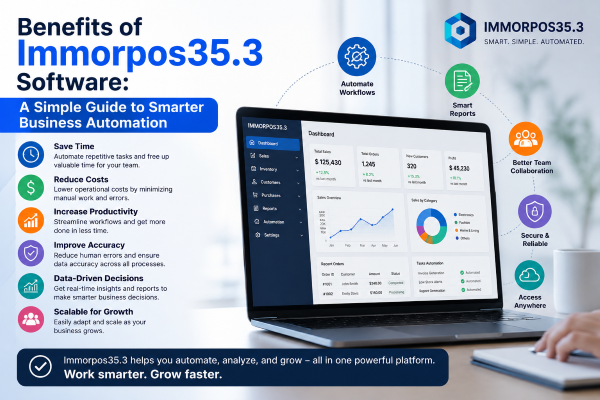
Running a business today means juggling a lot of moving parts. You have tasks to track, teams to manage, data to collect, and reports to prepare — often all at the same time. If you feel like your day disappears into small, repetitive jobs instead of the big decisions that actually grow your business, you are not alone. This is exactly the problem that business automation platforms are built to solve, and it’s why so many people are searching for the benefits of Immorpos35.3 software and tools like it.
In this guide, we’ll break down what this kind of software actually does, why businesses are turning to it, and how it can make daily work easier — all explained in plain, simple language. No confusing tech jargon, just clear, useful information you can actually use.
What Kind of Software Are We Talking About?
Before we get into the benefits, let’s set expectations. “Business automation software” is a broad category. It covers tools that help you:
- Automate repetitive tasks (so people don’t have to do them by hand)
- Bring data from different departments into one place
- Create reports and dashboards automatically
- Manage who can see or edit what
- Connect with other apps you already use
Products in this space — including ones marketed under names like Immorpos35.3 — generally promise to combine several of these functions into a single system. The exact features can vary a lot from one product to another, so it’s always smart to check a vendor’s official website, request a live demo, and read verified customer reviews before you commit to any specific tool. What we’ll focus on here are the general benefits this entire category of software offers, so you know what to look for and what questions to ask.
Why Businesses Are Interested in Automation Software Right Now
A few years ago, automation tools were mostly used by large corporations with big IT budgets. That has changed. Small and medium businesses are adopting these tools too, and there are some clear reasons why.
1. Manual Work Is Expensive
Every hour an employee spends copying data from one spreadsheet to another, or manually approving routine requests, is an hour they are not spending on higher-value work. Multiply that across a whole team, and the cost adds up fast — not just in salary, but in missed opportunities.
2. Mistakes Happen When Humans Do Repetitive Work
Nobody is perfect. When people do the same task over and over, small errors creep in — a wrong number typed here, a missed approval there. These small mistakes can turn into big problems, especially in areas like finance, inventory, or compliance.
3. Businesses Need Faster Answers
Waiting until the end of the month to find out how sales performed, or how a project is tracking against its budget, is no longer good enough. Competitive businesses want to know what’s happening right now, not two weeks ago.
These three pressures — cost, accuracy, and speed — are the main reasons companies look into platforms like Immorpos35.3 software in the first place.
Core Benefits of Business Automation Software
Let’s go through the main benefits you can generally expect from a well-built business automation and workflow platform.
Saves Time by Cutting Out Repetitive Work
The single biggest reason companies adopt automation software is time savings. Instead of manually sending approval emails, updating spreadsheets, or generating the same report every week, the software can be set up to do these things automatically based on rules you define.
For example:
- A new employee joins → the system automatically creates their accounts and sends a welcome checklist.
- A customer submits an order → the system automatically updates inventory and notifies the shipping team.
- A budget request goes over a certain amount → it’s automatically routed to a manager for approval.
None of this requires someone to sit and manually push each step forward. The time saved here can be redirected toward work that actually needs a human’s judgment.
Brings All Your Data Into One Place
Most businesses use several different tools — a spreadsheet for budgets, a separate app for tasks, another one for customer records, and maybe a messaging app for team updates. Over time, this creates “data silos,” where important information is scattered and hard to find.
A centralized platform pulls this information together into one dashboard. Instead of logging into five different apps to understand what’s happening, you can check one screen. This doesn’t just save time — it also reduces the chance that someone is working from outdated or incomplete information.
Gives You Real-Time Reporting
Old-fashioned reporting means waiting for someone to gather data, put it into a spreadsheet, and email it around — usually after the moment has already passed. Automation platforms are built to update dashboards in real time, so you can see current performance whenever you need it.
This matters because business conditions change quickly. If a marketing campaign is underperforming, you want to know today, not three weeks from now when the budget is already spent. Real-time data lets you catch problems early and adjust before they become expensive.
Reduces Human Error
Manual data entry is one of the most common sources of costly mistakes in business. A single typo in a spreadsheet formula, or a missed step in an approval chain, can cause real financial damage.
Automation software reduces this risk by removing the manual step altogether. Once a rule is set — for instance, “flag any invoice over $10,000 for manager review” — the system applies that rule consistently, every single time, without getting tired or distracted.
Makes Teams More Accountable
Good automation platforms include audit trails — a record of who did what, and when. This isn’t about micromanaging your team; it’s about clarity. If a task is late, you can see where it got stuck. If a number looks wrong, you can trace exactly where it came from.
This kind of visibility tends to naturally improve accountability, because everyone knows their actions are recorded and trackable.
Helps Businesses Scale Without Adding Headcount for Every Task
One of the more overlooked benefits is scalability. As a business grows, the number of tasks, approvals, and reports usually grows with it. Without automation, that often means hiring more people just to keep up with administrative work.
With automation in place, a lot of that growth can be absorbed by the system itself. A company processing 100 orders a day and a company processing 1,000 orders a day might use the exact same automated workflow — the software just runs it more times. This means you can grow your business without your operational costs growing at the same pace.
Improves Collaboration Across Teams
When sales, finance, operations, and customer support all work from the same connected system, communication naturally improves. Instead of sending files back and forth by email, teams can see shared, updated information directly.
This reduces the classic “wait, is this the latest version?” problem that happens when everyone works from separate spreadsheets. It also helps new employees get up to speed faster, since they don’t need to hunt down information scattered across five different tools.
Supports Better Decision-Making
At the end of the day, all of these benefits point toward one big outcome: better decisions. When you have accurate, real-time information in one place, you’re not guessing. You can see which products are performing well, where costs are creeping up, and which processes are creating bottlenecks.
Business leaders who rely on outdated or incomplete data often make decisions based on gut feeling alone. Automation software doesn’t replace good judgment, but it gives that judgment much better information to work with.
Often Connects With Tools You Already Use
Most modern automation platforms are designed to work alongside your existing software rather than force you to replace everything overnight. Integration with common tools — spreadsheets, cloud storage, CRMs, and communication apps — is a standard feature businesses should look for, since it makes adoption far less disruptive.
Who Actually Benefits From This Kind of Software?
It’s a common myth that automation software is only useful for large enterprises. In reality, businesses of almost any size can benefit, just in different ways.
Small businesses often benefit most from time savings. A small team wearing many hats doesn’t have spare hours to spend on manual data entry, so even simple automations can free up meaningful time.
Mid-sized businesses tend to benefit from the centralization piece the most. As a company grows past a certain size, keeping everyone aligned without a shared system becomes genuinely difficult.
Larger organizations usually get the most value from advanced reporting, access control, and audit trails, since they need tighter oversight across many departments and locations.
Things to Check Before Choosing Any Automation Software
Since products in this category — including ones marketed as Immorpos35.3 software — can vary widely in what they actually deliver, it’s worth doing your homework before signing up. Here’s a simple checklist:
- Look for an official, verifiable source: Check that the company has a real website, transparent pricing, and contact information — not just third-party blog posts describing the product.
- Ask for a live demo: A genuine platform should be able to show you the software working in real time, not just describe it in marketing copy.
- Read independent reviews: Look for reviews on established software review platforms, not only content published by the vendor itself or affiliated blogs.
- Confirm integration support: Make sure it actually connects with the tools your team already relies on.
- Understand the pricing model clearly: Know exactly what you’re paying for, including any limits on users, storage, or automation rules.
- Test the security features: Ask about data encryption, backups, and access controls, especially if you’ll be storing sensitive business or customer information.
Taking these steps protects you from vague or inconsistent claims and helps you choose a tool that genuinely fits your business.
Common Challenges to Keep in Mind
No software is a magic fix, and it’s worth being realistic about the learning curve involved.
- Setup takes time: Automating your workflows means first mapping them out clearly, which can take longer than expected if your current processes are messy or undocumented.
- Team adoption matters: Even the best software won’t help if your team doesn’t actually use it. Training and clear communication about “why” the change is happening go a long way.
- Not every task should be automated: Some decisions genuinely need a human’s judgment. The goal of automation is to remove repetitive, rules-based work — not to replace thoughtful decision-making.
Final Thoughts
The appeal behind the benefits of Immorpos35.3 software — and business automation platforms in general — comes down to a simple idea: spend less time on repetitive manual work, and more time on the decisions that actually move your business forward. Centralized data, real-time reporting, fewer errors, and easier collaboration are the core promises of this software category, and when implemented well, they can genuinely change how a business operates day to day.
That said, because this space includes tools of very different quality and legitimacy, always verify any specific product through official channels before making a purchase or subscription decision. Look past marketing claims, ask for demos, and read independent reviews. A good automation platform should be able to prove its value with a real demonstration — not just a well-written blog post.
If you’re evaluating options, start by listing your three biggest time-wasting tasks this month. Whatever software you choose — automation platform, workflow tool, or business management system — should be able to show you, clearly and concretely, exactly how it solves those three problems.