

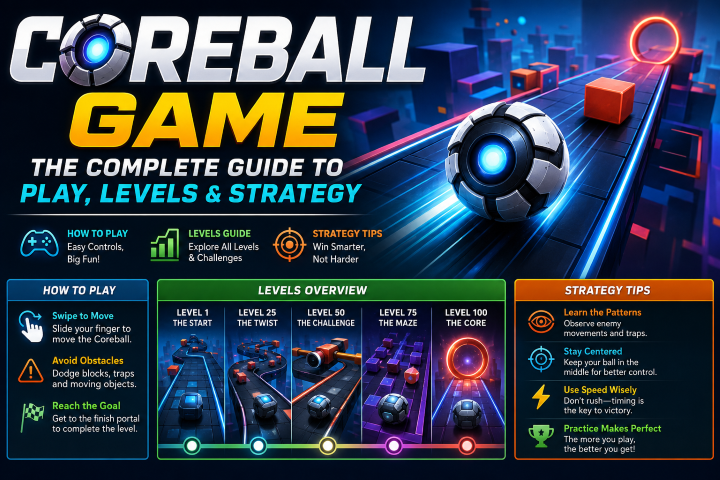
If you’ve spent any time browsing casual browser games over the past few years, chances are you’ve stumbled across a small spinning circle in the center of your screen, surrounded by tiny balls waiting to be launched. That’s Coreball — a deceptively simple game that has quietly built one of the most loyal followings in the browser gaming world. What starts as an easy, almost lazy click-to-shoot experience quickly turns into a nerve-wracking test of timing, patience, and pattern recognition.
In this guide, we’ll break down everything there is to know about Coreball: what it is, how it works, why it’s so hard to put down, the best strategies for climbing through its levels, and where you can play it online for free.
What Is Coreball?
Coreball (sometimes written as “Core Ball”) is a free, browser-based arcade game built around one simple mechanic. A ball sits rotating in the center of the screen, and the player must launch a series of smaller balls toward it. Each ball needs to attach itself to the rotating core without colliding with any of the balls that are already stuck there. A single collision ends the round.
The game originally launched in 2015 and has been steadily expanded ever since, growing from a modest 60 levels to editions offering well over 100, 200, and even 500 levels depending on which version of the game you’re playing. Different sites host their own versions of Coreball, and level counts vary — some hover around 90 or 130 levels, while more expansive editions push past 200 or even 500.
What makes Coreball stand out isn’t flashy graphics or a complicated storyline. It’s the elegant simplicity of the core loop: aim, time your shot, and hope for the best. That “one more try” pull is what has kept players coming back to it for close to a decade.
How Coreball Works: The Basic Mechanics
At its heart, Coreball uses a one-click (or one-tap) control scheme, which makes it instantly accessible on both desktop and mobile devices. Here’s the basic breakdown of how a typical round plays out:
- A core ball spins in the center of the screen. In many levels, it already has a few balls pre-attached to it, which you’ll need to avoid.
- Smaller balls wait around the edge of the screen, ready to be launched toward the core.
- You click or tap to fire a ball toward the rotating core.
- The ball needs to land in an open gap between the already-attached balls. If it touches another ball on the way in, the round ends immediately.
- Once all balls are successfully attached, you clear the level and move on to the next one.
It sounds straightforward, and for the first several levels, it genuinely is. But as you progress, three variables start working against you: rotation speed increases, the number of pre-attached balls grows, and the timing windows for a clean shot shrink. That combination is what transforms Coreball from a lighthearted time-killer into a legitimate test of reflexes.
Why Coreball Is So Addictive
There’s a reason Coreball has maintained a dedicated player base for nearly a decade while countless other browser games have faded into obscurity. A few design choices are responsible for that staying power.
It’s Instantly Understandable
There’s no tutorial to sit through, no menu to dig through, no story to skip. You load the page, see the spinning core, and immediately understand the goal. That low barrier to entry is a big part of why Coreball spreads so easily — it’s the kind of game someone can start playing during a five-minute break without any explanation.
The Difficulty Curve Is Deceptively Smart
Early levels lull you into a false sense of confidence. Most players cruise through the first fifteen to twenty levels without much trouble. Then, somewhere around level 20, the game quietly shifts gears. Rotation speeds pick up, gaps get tighter, and directional reversals start appearing — meaning the core can suddenly switch spin direction mid-shot. This is widely regarded as the point where casual players start dropping off and where the “real” game begins for those chasing mastery.
It Rewards Pattern Recognition, Not Luck
Once you’ve played enough rounds, you start to notice that each level has a rhythm. Skilled players aren’t relying on chance — they’re reading the rotation speed, anticipating the gap, and timing their click to the fraction of a second. This turns Coreball into something closer to a rhythm game than a pure reflex test, and that skill-based depth is what keeps competitive players engaged long after casual players have moved on.
Short Sessions, High Replay Value
A single round of Coreball can be over in seconds if you make a mistake, or it can stretch a couple of minutes if you’re navigating a genuinely tough level. Either way, rounds are short enough that “just one more try” is an easy mental trap to fall into — and that’s exactly the loop that has made the game a favorite for quick breaks throughout the day.
The History of Coreball: From 60 Levels to Hundreds
Coreball’s story is one of steady, almost stubborn iteration. The game first appeared in 2015 with a modest 60 levels, built around the same core mechanic it still uses today. It didn’t launch with fanfare or viral marketing — it simply existed as a small, well-made timing game, and word of mouth did the rest.
A few weeks after the original release, the developers added 30 additional levels, pushing the total to 90. For a while, that was the complete Coreball experience, and it was more than enough to build a loyal following of players chasing personal bests and bragging rights among friends.
The bigger shift came later, when the game’s interface was overhauled to include a level-select screen starting at level 91. This update mattered more than it might sound: instead of forcing players to replay from the very beginning every time they wanted to revisit an earlier stage, they could now jump straight to any level they’d already cleared. It was a small quality-of-life change, but it transformed Coreball from a purely linear experience into something closer to a practice tool, where players could drill a specific tricky stage without wading through easier ones first.
This kind of long-tail support is rare for a browser game. Most casual web games either get abandoned within a year or two, or they get absorbed into larger platforms and lose their original identity. Coreball has done neither — it has quietly persisted, adding content roughly on its own schedule, for the better part of a decade.
The Anatomy of a Coreball Level
To really understand why Coreball levels feel so different from one another despite sharing the same basic rules, it helps to break down the individual variables that designers can adjust:
- Rotation speed: How fast the core spins. This is the most obvious difficulty lever, and it scales steadily as you progress through the levels.
- Number of pre-attached balls: Some levels start you off with just a couple of balls already stuck to the core, while others load it up with eight, ten, or more before you’ve even taken your first shot. More pre-attached balls means fewer open gaps and a much tighter margin for error.
- Gap size: Even at the same rotation speed, the size of the openings between attached balls can vary. Later levels favor narrow gaps that demand pixel-perfect timing.
- Direction changes: In advanced levels, the core doesn’t spin at a constant rate in a single direction. It can slow down, speed up, or reverse entirely, forcing players to constantly recalculate their timing rather than relying on a memorized rhythm.
- Ball launch angle: Depending on the version of the game, balls may launch from a fixed position or from varying angles around the screen, which changes how you need to read the core’s rotation relative to your shot.
Understanding these variables is useful because it reframes how you should approach a new level. Instead of thinking “this level is hard,” it helps to ask “is this level hard because of speed, density, or direction changes?” That diagnostic mindset tends to speed up learning considerably, since it tells you exactly what to watch for on your next attempt.
Coreball Levels: What to Expect as You Progress
Because Coreball has been continuously updated since its 2015 launch, level counts differ depending on where you play. Some versions cap out around 90 or 130 levels, while more actively maintained editions have expanded well beyond 200, with some claiming as many as 500 levels total.
Regardless of the exact count, the general progression tends to follow a familiar shape:
- Levels 1–15: Slow rotation, wide gaps, minimal pre-attached balls. This is the tutorial zone, even without an explicit tutorial.
- Levels 16–25: Rotation speed increases noticeably. This is typically cited as the point where the game starts separating casual players from more dedicated ones.
- Levels 25–50: Expect tighter gaps, more pre-attached balls (sometimes eight, ten, or more depending on the level), and less room for error.
- Levels 50+: Direction reversals, faster spins, and denser cores become the norm. Reaching this stage generally puts a player in a fairly small percentage of those who have played the game.
- Advanced levels (100+): Reserved for players who have essentially mastered the timing mechanics. Progress here is slow and deliberate, often measured in individual levels rather than batches.
Some versions of the game have also added quality-of-life features over time, such as level-select menus that let you replay previously completed stages, daily bonus wheels offering small power-ups, and personal statistics tracking so you can compare your attempt counts and completion times against your own history.
Strategies to Get Better at Coreball
If you’re stuck bouncing off the same level over and over, here are some practical strategies that experienced players swear by.
1. Watch a Full Rotation Before You Shoot
It’s tempting to fire the instant a gap appears, but the smarter move is to watch the core complete at least one rotation first. This gives you a feel for its speed and helps you predict exactly when a gap will line up with your shot’s trajectory, rather than reacting purely on instinct.
2. Focus on the Gap, Not the Balls
New players often fixate on the balls already attached to the core, which naturally causes hesitation. Shift your focus instead to the open gap itself. Thinking in terms of “where do I need to land” rather than “what do I need to avoid” tends to produce cleaner, more confident shots.
3. Learn to Anticipate Direction Reversals
In later levels, the core won’t just spin faster — it will occasionally reverse direction without warning. The only real defense against this is repetition. The more you play a specific level, the more you’ll start to recognize its reversal pattern, since many levels repeat the same rotation logic on every attempt.
4. Slow Down on Tight Levels
Speed is not the goal in the early stages of learning a new level. Prioritize accuracy first. Once you’ve cleared a level slowly and understand its pattern, your reaction time naturally improves the more times you replay it.
5. Take Short Breaks After Repeated Failures
Coreball’s difficulty spikes can be genuinely frustrating, and frustration tends to worsen timing rather than improve it. If you’ve failed the same level five or six times in a row, stepping away for even thirty seconds often resets your focus more effectively than grinding through fatigue.
6. Use Power-Ups Strategically (If Available)
Some versions of Coreball include occasional power-ups — such as items that temporarily slow the core’s rotation — earned through daily bonuses or achievements. Save these for levels that have been giving you consistent trouble rather than using them on stages you can already clear reliably.
Coreball Variants and Where to Play
Because Coreball’s core concept is so simple, it has been recreated and rebranded across numerous gaming sites over the years, each with slightly different level counts, art styles, and bonus features. You’ll find versions such as:
- Original Coreball, hosted on its originating platform, which has expanded to hundreds of levels and includes speedrun tracking and global statistics.
- Core Ball editions on general arcade gaming hubs, often stripped down to a clean, no-frills version focused purely on the core mechanic.
- CoreBall variants with alternate level counts (some around 130, others around 216), typically featuring their own FAQ sections explaining ball-attachment mechanics for new players.
- Mobile adaptations, such as arrow-and-shoot style versions available on app stores, which add music, additional visual polish, and expanded level variety for players who prefer a native app experience over a browser tab.
- Unblocked or school-friendly versions, popular among students looking for a quick, browser-based distraction that doesn’t require downloads or installations.
Whichever version you choose, the underlying gameplay loop remains essentially the same: aim, time your shot, and avoid collisions.
Coreball vs. Other Timing-Based Browser Games
Coreball belongs to a broader genre of minimalist, timing-based browser games — the kind that trade complex graphics for a single, tightly tuned mechanic. It’s worth understanding how it compares to similar games, both to appreciate what makes it distinct and to help you decide whether it’s the right fit for your particular taste in casual games.
Compared to reflex-only games: Many browser games in this space rely purely on raw reaction speed — react to a signal as fast as possible, with little room for strategy. Coreball is different because the core’s rotation is often predictable within a given level, meaning skilled players aren’t just reacting faster, they’re reading the pattern and timing their input proactively.
Compared to puzzle games: Unlike traditional puzzle games where you can pause and plan indefinitely, Coreball’s puzzles are dynamic — the core never stops spinning while you think. This blend of puzzle-like problem solving (where’s the safest gap?) with real-time pressure (you have to act now) is part of what gives the game its distinct feel.
Compared to endless arcade games: Many arcade-style browser games are endless, with a single score that climbs until you fail. Coreball instead uses a discrete level structure, which gives players clear goals and a sense of steady progression rather than an open-ended chase for a high score.
The Coreball Community and Competitive Scene
While Coreball isn’t a mainstream esport, it has developed a small but genuinely dedicated competitive community over the years. Speedrunning is one of the more popular ways players engage with the game beyond simply clearing levels. Because early levels can be completed in just a few seconds once a player has memorized the rotation pattern, speedrunners compete to clear specific level ranges — such as the first ten or twenty stages — as quickly as possible, comparing times against community benchmark records set by experienced players.
Global statistics tracking has also fostered a light sense of national competition. Some versions of the game display country-by-country data on average level reached, turning individual progress into something like a collective scoreboard. It’s common to see players from certain regions cited as leading the pack, often attributed informally to broader gaming culture trends in those countries — though of course, individual skill varies enormously regardless of location.
Video content has played a role in keeping the community active as well. Skilled players occasionally record and share gameplay footage of particularly tough level clusters, especially runs through notoriously difficult level clusters in the 100–250 range, giving newer players a reference for pacing and technique. Watching a clean, confident run of a level you’ve been stuck on can be more instructive than any written guide, since it shows you exactly where in the rotation the “safe window” for your shot actually is.
Tips for Streaming or Recording Your Coreball Sessions
If you’re interested in sharing your Coreball progress — whether for a speedrun community, a casual gaming channel, or just to track your own improvement over time — a few practical tips can make the experience smoother:
- Play in full-screen mode: when possible. Browser chrome and toolbars can be distracting both for you and for anyone watching a recording, and full-screen mode also gives you a slightly larger target area to judge your shots against.
- Keep a written log of tricky levels: Note the level number and roughly what makes it hard (speed, density, direction changes). Over time, this turns into a personalized troubleshooting guide you can reference before attempting a comeback run.
- Record in short segments: Because individual rounds are quick, there’s no need to capture long uninterrupted sessions. Short clips focused on a specific tough level tend to be more useful, both for your own review and for sharing with others.
- Compare your attempt counts, not just your completion: Many versions of Coreball track how many tries a level took you. Watching that number trend downward over repeated sessions is often more motivating than simply seeing a level marked “complete.”
Is Coreball Hard to Play?
Coreball is easy to learn but genuinely challenging to master, and that distinction is central to its appeal. The one-click control scheme means there’s no complicated input system standing between you and the action. Anyone can pick it up in seconds.
The actual difficulty comes entirely from timing and pattern recognition, not from mechanical complexity. This makes Coreball a good example of what game designers often call “easy to learn, hard to master” design — a philosophy shared by other enduring casual classics. It’s approachable enough for a complete beginner to enjoy in short bursts, yet deep enough that dedicated players can spend real time refining their reaction speed and reading rotation patterns.
Most players can expect to work through the first hundred levels in roughly one to two hours, though this varies significantly based on individual timing skill and how quickly someone adapts to the increasing difficulty curve.
Frequently Asked Questions About Coreball
Is Coreball free to play? Yes. Coreball is a free browser game that requires no downloads, installations, or account creation on most platforms hosting it. You simply open the page and start playing.
Can I play Coreball on mobile? Yes. Because Coreball relies on a simple tap-to-shoot control scheme, it adapts well to touchscreens, and several mobile app versions exist in addition to the standard browser editions.
How many levels does Coreball have? This depends on the version you’re playing. Some editions offer around 90 to 130 levels, while more actively updated versions have expanded to 200, 216, or even 500 levels over time.
What happens if my ball hits another ball? A collision between your launched ball and any ball already attached to the core ends the round immediately, and you’ll need to restart that level.
Why does the game suddenly get harder around level 20? Around this point, most versions of Coreball introduce faster rotation speeds and tighter gaps between attached balls, which is commonly cited as the stage where casual players begin to struggle and drop off.
Does Coreball save my progress? Many versions track your stats locally in your browser, including personal records, attempt counts, and completion times, so you can monitor your improvement over repeated sessions.
Final Thoughts
Coreball’s longevity says a lot about what makes a casual game genuinely great. It doesn’t rely on elaborate visuals, complex controls, or a sprawling narrative. Instead, it leans entirely on a single, well-tuned mechanic — timing a shot against a spinning target — and lets difficulty scale naturally as players improve. That’s a hard balance to strike, and it’s a big part of why Coreball has managed to stay relevant since 2015, continually adding new levels and features while keeping its core gameplay untouched.
Whether you’re looking for a quick way to kill five minutes or you’re chasing a personal best on a brutal level 50 stage, Coreball delivers exactly the kind of “just one more try” experience that has made it a staple of browser gaming for nearly a decade. Load it up, watch the core spin, and see how far your timing can take you.
