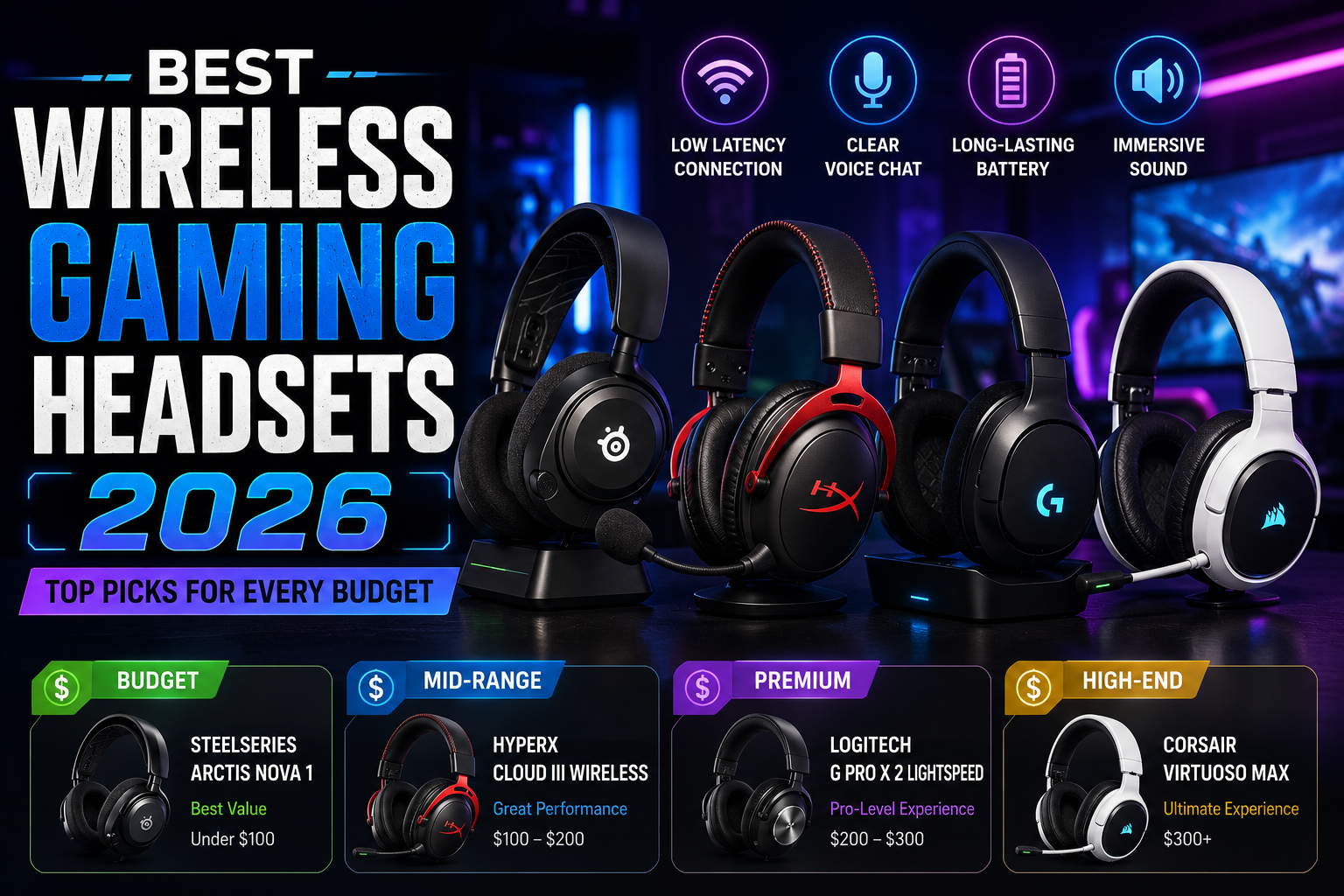
A great gaming headset does two jobs at once: it lets you hear exactly where an enemy is creeping up from in a competitive shooter, and it lets your teammates hear you clearly without a wall of background noise. In 2026, wireless gaming headsets have gotten good enough that there’s genuinely no reason to stay tethered to your PC or console anymore — battery life, latency, and audio fidelity have all matured to the point where wireless is now the default choice for most gamers, not a compromise.
This guide breaks down what actually matters when buying a wireless gaming headset, and which models are worth your money across different budgets and use cases in 2026.
Do You Even Need a Dedicated Gaming Headset?
Before diving into recommendations, it’s worth being honest about something most gaming headset guides gloss over: a good pair of regular wireless headphones can work just as well, or sometimes even better, than headsets specifically marketed for gaming — provided you’re comfortable adding a separate microphone. What a dedicated gaming headset actually gets you is a built-in mic designed for clear voice chat with friends and teammates, tuned specifically for that use case. If you already own quality headphones and just need voice comms, a clip-on or desk mic might be all you’re missing. But if you want an all-in-one solution, the picks below are worth your attention.
Also worth flagging: there’s no shortage of headsets on the market that are little more than regular headphones with aggressive gaming branding slapped on. The recommendations below have been filtered specifically for genuine gaming-focused performance, not just marketing.
What Actually Matters When Choosing a Wireless Gaming Headset
Latency
This used to be the single biggest concern with wireless gaming audio — any noticeable delay between an in-game sound event and hearing it is a genuine competitive disadvantage. Modern gaming headsets almost universally rely on dedicated 2.4GHz wireless connections (rather than standard Bluetooth) specifically because they deliver latency low enough to be indistinguishable from wired audio in practical use. If a headset only offers Bluetooth as its wireless option, treat that as a yellow flag for competitive use.
Battery Life
Look for headsets offering at least 20-plus hours of battery life on a single charge — anything less becomes a genuine hassle for regular, longer gaming sessions. Some premium models now offer hot-swappable batteries specifically so you never have to stop playing to recharge, which is a meaningful convenience if you game for extended stretches regularly.
Comfort for Long Sessions
Weight and headband design matter more than most buyers expect. A headset under roughly 320 grams with genuine memory foam ear cushions will noticeably reduce fatigue over multi-hour sessions compared to heavier designs. Some manufacturers use a “ski goggle” style suspension headband instead of a traditional padded headband — this distributes weight differently across the head and can be more comfortable for people with larger or unusually shaped heads, though it comes down to personal preference.
Microphone Quality
For team-based competitive games, mic clarity matters just as much as audio output quality. Look specifically for a detachable or retractable microphone with genuine noise rejection — this cuts down on background noise being transmitted to your teammates, which matters a lot if you don’t have a quiet, isolated gaming space.
Multi-Platform Compatibility
If you regularly switch between PC, PlayStation, Xbox, or Nintendo Switch, check compatibility carefully before buying. Many premium headsets now support all major platforms through a combination of 2.4GHz wireless and Bluetooth, but budget models sometimes lock you into a single ecosystem.
Active Noise Cancellation (ANC)
Once rare in gaming headsets, genuine ANC is now available in several premium 2026 models. This is a real advantage if you game in shared spaces, noisy environments, or simply want to fully immerse yourself without external distractions — though it typically adds meaningfully to the price.
Top Wireless Gaming Headset Picks for 2026
Best Overall Premium Pick: SteelSeries Arctis Nova Pro Wireless
This headset remains one of the strongest all-round recommendations in the premium wireless category. It uses SteelSeries’ signature “ski goggle” suspension headband design, distributing weight comfortably across extended sessions, paired with premium, replaceable ear cushions and an angled driver design intended specifically to improve soundstage imaging — a genuine advantage for pinpointing directional audio in competitive titles.
Its standout feature is the Infinity Power System, a hot-swappable dual-battery setup that effectively eliminates downtime for charging — you simply swap in a charged battery without ever needing to pause your session. Combined with active noise cancellation and a retractable ClearCast Gen 2 microphone, this is genuinely one of the most complete premium wireless gaming headsets available right now.
Best for: Serious gamers who want the most complete feature set and don’t mind paying a premium price for it.
Best Premium Alternative: Razer BlackShark V3 Pro
The BlackShark V3 Pro takes a more traditional gaming headset approach: a lightweight, under-320-gram frame with memory foam ear cushions and a circumaural over-ear fit that provides genuinely good passive noise isolation. Its lighter weight translates into noticeably reduced fatigue during marathon sessions compared to heavier premium alternatives.
Audio-wise, it delivers strong, punchy sound backed by Razer’s THX Spatial Audio processing — a genuine strength for gaming-first users who prioritize impactful sound effects and clear positional audio cues over neutral, audiophile-tuned sound signatures. It also includes active noise cancellation, a rarity outside the very top tier of gaming headsets.
Best for: Buyers who prioritize lightweight comfort and punchy, gaming-tuned sound over the Arctis Nova Pro’s broader feature set.
Best Budget-Friendly Competitive Pick: Razer BlackShark V3 X HyperSpeed
For competitive gamers who don’t need every premium feature, this streamlined version delivers the core BlackShark experience at a more accessible price point. It features Razer’s TriForce 50mm Gen-2 drivers, a lightweight 270-gram design, dual 2.4GHz and Bluetooth connectivity, and an impressive 70-hour battery life on wireless mode — genuinely excellent longevity that beats out several pricier competitors.
Best for: Competitive players who want reliable, low-latency wireless performance without paying premium-tier prices.
Best for Open-Back Comfort: Turtle Beach Atlas Air
One of the few wireless headsets on the market with a genuine open-back design, meaning the earcups don’t fully seal off your ears from outside air and sound. This creates a more spacious, natural, and enveloping soundstage that works particularly well for both competitive titles (where hearing directional audio clearly matters) and story-driven single-player games. The tradeoff is real: open-back designs sacrifice noise isolation and leak sound outward, so this is best suited to quieter home environments rather than shared or noisy spaces.
Best for: Gamers who prioritize natural, spacious soundstage over noise isolation, and who game in a reasonably quiet room.
Best Mid-Range All-Rounder: SteelSeries Arctis Nova 7
A more affordable step down from the Nova Pro lineup, retaining much of the comfort and audio quality SteelSeries is known for at a noticeably lower price point. A strong pick for gamers who want the brand’s signature comfort and reliability without paying flagship prices.
Best Value Corsair Pick: Corsair HS80 MAX Wireless
Designed for daily gaming rather than top-tier competitive esports, the HS80 MAX combines immersive audio, a comfortable suspension headband, and flexible low-latency wireless connectivity with personalized sound tuning — a dependable, comfortable choice for players who want consistent, reliable performance across long sessions without chasing every premium spec.
Wireless Gaming Headsets: Quick Comparison by Priority
- Prioritizing battery life and zero downtime? SteelSeries Arctis Nova Pro Wireless (hot-swappable batteries) or Razer BlackShark V3 X HyperSpeed (70-hour single charge).
- Prioritizing lightweight comfort for long sessions? Razer BlackShark V3 Pro or Razer BlackShark V3 X HyperSpeed, both under 320 grams.
- Prioritizing the most complete feature set regardless of price? SteelSeries Arctis Nova Pro Wireless.
- Prioritizing natural, spacious soundstage over isolation? Turtle Beach Atlas Air.
- Prioritizing value without sacrificing brand reliability? SteelSeries Arctis Nova 7 or Corsair HS80 MAX Wireless.
Common Mistakes to Avoid When Buying
Don’t assume Bluetooth-only means it’s suitable for competitive gaming. Always confirm a dedicated 2.4GHz wireless connection is included if low latency matters to you — Bluetooth alone, while convenient for casual use, isn’t the gold standard for competitive audio timing.
Don’t ignore weight if you play for multiple hours at a stretch. A headset that feels fine for twenty minutes in a store can become genuinely uncomfortable after a three-hour gaming session. Where possible, check reviews specifically discussing extended-wear comfort, not just initial impressions.
Don’t overlook microphone quality in favor of audio output. If you regularly play team-based games, a headset with excellent sound but a mediocre, noise-picking-up microphone will actively hurt your team communication — check dedicated mic-quality reviews, not just general audio impressions.
Don’t buy based on branding alone. As with most gaming peripheral categories, there are plenty of headsets riding purely on flashy branding and RGB lighting without genuinely competitive audio performance underneath. Stick to models with verified, hands-on reviews from dedicated audio-testing outlets.
Final Verdict
For most gamers in 2026, the SteelSeries Arctis Nova Pro Wireless remains the benchmark premium pick — its hot-swappable battery system alone solves one of the most persistent annoyances in wireless gaming audio, and its comfort and audio quality hold up across extended sessions. If you want something lighter with punchier, more gaming-tuned sound, the Razer BlackShark V3 Pro is a genuinely excellent alternative at a similar price tier.
For budget-conscious buyers who still want reliable, low-latency competitive performance, the Razer BlackShark V3 X HyperSpeed delivers the core experience that matters most — solid drivers, dual wireless connectivity, and standout battery life — without the premium price tag. Whichever tier you’re shopping in, prioritize genuine 2.4GHz wireless latency and real-world comfort over spec-sheet extras, and you’ll end up with a headset that actually improves how you play, not just how your setup looks.
Note: Pricing, availability, and specific model configurations mentioned in this guide reflect data available as of mid-2026 and may vary by region and retailer. Always check current listings and reviews before purchasing.
Frequently Asked Questions
Is wireless audio latency still a concern for competitive gaming in 2026?
Generally, no. Modern gaming headsets that use dedicated 2.4GHz wireless connections, rather than standard Bluetooth alone, deliver latency low enough to be functionally indistinguishable from wired audio during actual gameplay. Bluetooth-only headsets are a different story and are better suited to casual use than competitive play.
Do I need active noise cancellation on a gaming headset?
Only if you regularly game in shared or noisy environments, or simply want maximum immersion without external distractions. ANC adds meaningfully to the price, so if you typically game in a quiet room, you can save money by skipping it in favor of a headset that focuses purely on audio quality and comfort.
What’s the difference between open-back and closed-back gaming headsets?
Open-back headsets, like the Turtle Beach Atlas Air, don’t fully seal your ears off from outside air and sound, which creates a more natural, spacious soundstage — genuinely useful for hearing directional audio cues. The tradeoff is reduced noise isolation and sound leakage outward, making them better suited to quiet home environments than shared spaces. Closed-back headsets seal more completely, trading some soundstage naturalness for better isolation.
How important is microphone quality compared to audio output?
Just as important, if not more, for team-based competitive games. A headset with excellent sound but a poor, noise-picking-up microphone will actively hurt your ability to communicate clearly with teammates. Look specifically for detachable or retractable mics with genuine noise rejection rather than judging a headset purely on its audio output reviews.
Can I use a gaming headset across PC, PlayStation, and Xbox?
Many premium 2026 headsets do support multi-platform use through a combination of 2.4GHz wireless and Bluetooth, but this varies by model and isn’t guaranteed, especially with budget options. Always check the specific compatibility list for a headset before buying if you regularly switch between platforms.
Is it worth paying extra for a hot-swappable battery system?
If you game for long, uninterrupted stretches regularly, yes — a hot-swappable dual-battery setup like the one on the SteelSeries Arctis Nova Pro Wireless effectively eliminates any downtime for charging. If your sessions are typically shorter, a headset with strong single-charge battery life, like the 70-hour Razer BlackShark V3 X HyperSpeed, may be a more cost-effective choice instead.